Were the roots traced through the parchment - and what turned up instead
Roots and bifolia: what one hunch led to
Updated 08.10.2026
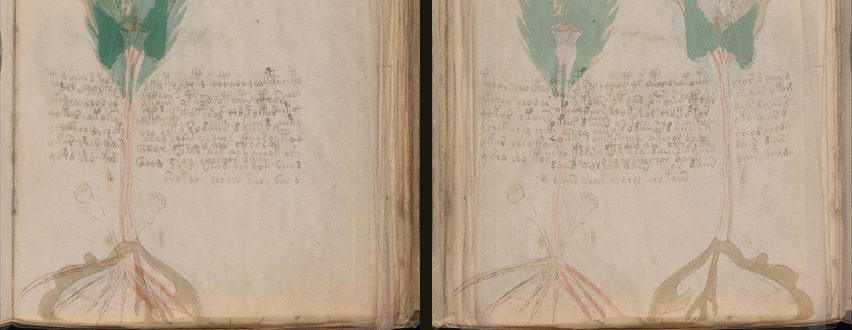
On the page See-through parchment the mirrored back of a leaf lies under its front. Looking at this overlay, Vitaly Averyanov noticed that the roots of the plants on the two sides of a leaf fall at the same height. Hence the hunch: the leaf was laid against the light and the root of the plant on the other side was traced - which would explain the herbal's well-known "confused roots". We tested it in a way that cannot be tuned to the answer - and found not what we were looking for, but something solid.
How we tested
Rules before data
First we wrote and published a preregistration: what is measured, against what, and which result means what. The thresholds do not change afterwards.
Blind marking
118 herbal pages (59 leaves) were shown one at a time in shuffled order, the front and back of a leaf far apart. On each page the coder drew a box around the root mass and placed a "neck" point where the stem turns into the root. Six pages were repeated blind - the marking agreed with itself (overlap 0.53-0.96).
Comparison with a shuffle
The back of each leaf is mirrored into the coordinates of its front - the way it lies when seen against the light. The agreement of the true pairs is compared with the same number for random pairs of leaves: if roots were traced, true pairs must agree clearly better.
First answer: no tracing through the parchment
No measure passed the preset threshold: box overlap 0.302 against 0.273 for random pairs (p 0.012), the distance between necks as for random pairs (p 0.54), the height difference 0.063 against 0.079 (p 0.0075) at a threshold of 0.0033. This is a strong negative: the same test finds an artificial tracing in 100 % of cases. Had the roots been copied from the other side, we would have seen it. Similar root heights occur for random leaves as well - the root is simply drawn near the bottom of the page.
Second answer, unexpected: the unit is the bifolium
If the back is laid without mirroring - the way the page looks when read - the roots of front and back agree better than chance. We checked which other pages do this. It turns out: all four pages of one bifolium, the folded sheet that makes two leaves of the book. Neighbouring pages, facing pages and other leaves of the same quire do not.
The honest test shuffles not page pairs but the bifolia themselves among the leaves: 0.431 against 0.361 ± 0.016, p 0.0005. Leaf size plays no role - in absolute pixels the result is the same, and the two halves of a bifolium are no closer in height than random leaves.

A check without a human
A single coder is a weak point, so we repeated the test with an automatic mask: a program finds the ochre paint of roots on the scans by itself (parameters set on eight pages before the test and then frozen, preregistration #206). Same result: pages of one bifolium agree in root position (z +3.7, p 0.0005). But the control showed something important: the text in the upper half of the leaf agrees by bifolium almost as much (z +3.35). So the whole folded sheet was laid out in one go - the place for the plant and the place for the text.
Are there identical roots on different leaves?
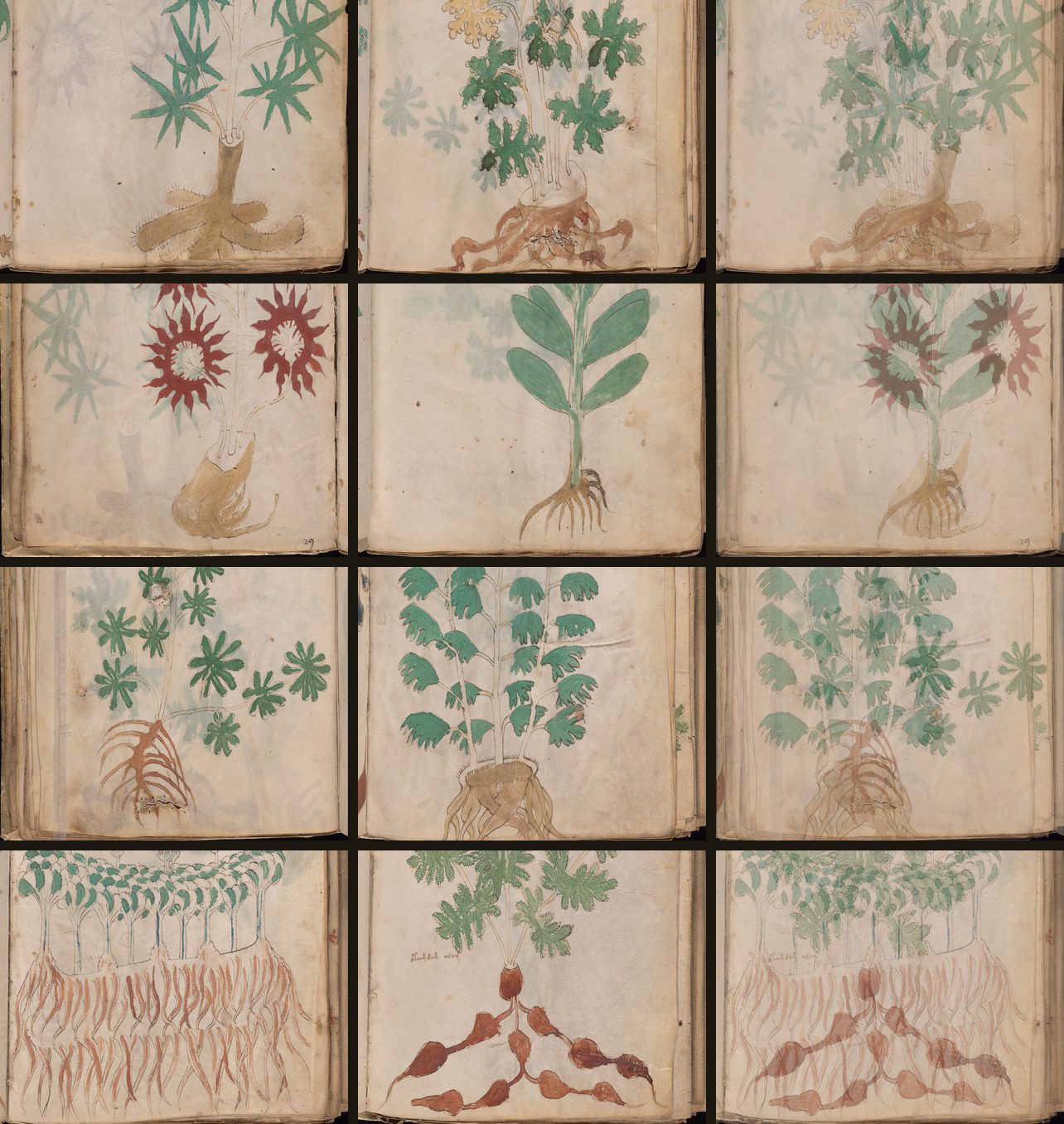
Among all 6 300 page pairs we took those whose root masks agree most and overlaid them. The place agrees, the shapes do not: one root is a "paw", another a tuber, a third a comb. No copying of roots from leaf to leaf is visible.
What was known before
That the herbal was produced bifolium by bifolium is known from the script: Prescott Currier noticed that scribes 1 and 2 alternate in the herbal by bifolium, and Lisa Fagin Davis showed that the bifolia were later rebound out of order. A layout rule is known too: text avoids the roots. What we add is quantitative: within a bifolium the geometry also agrees - the place for the root and the place for the text. And it is more than "one hand": with bifolia shuffled only within one scribe the agreement remains (roots z +3.0, text z +2.9, p 0.0025; a check made after the main one).
Bottom line
The herbal's roots were not traced through the parchment - tested blind and with power to spare. Instead we see how the book was made: the herbal was laid out bifolium by bifolium, before sewing, in one go for the whole folded sheet - where the text goes and where the plant stands. The roots themselves were drawn one by one. This is an observation about production technique; it brings no reading of the text and implies none.
What we do not claim: that bifolium-wise production is unknown to codicologists (scribal work by bifolium is known, see above); that one person did the layout; that the bifolia are now in their original order. Data, code and both preregistrations are on Zenodo: 10.5281/zenodo.23219862 (v1, before data), 10.5281/zenodo.23228549 (v2, result); the bifolium finding - 10.5281/zenodo.23229720.