Hoax and gibberish
Autocopying: how we rejected the strongest gibberish version
Torsten Timm proposed a mechanism with no stencil and no tables at all: the scribe copies what is already on the page and changes it a little. Such a generator really does reproduce a great many of the Voynich numbers. We found six features it cannot reproduce.
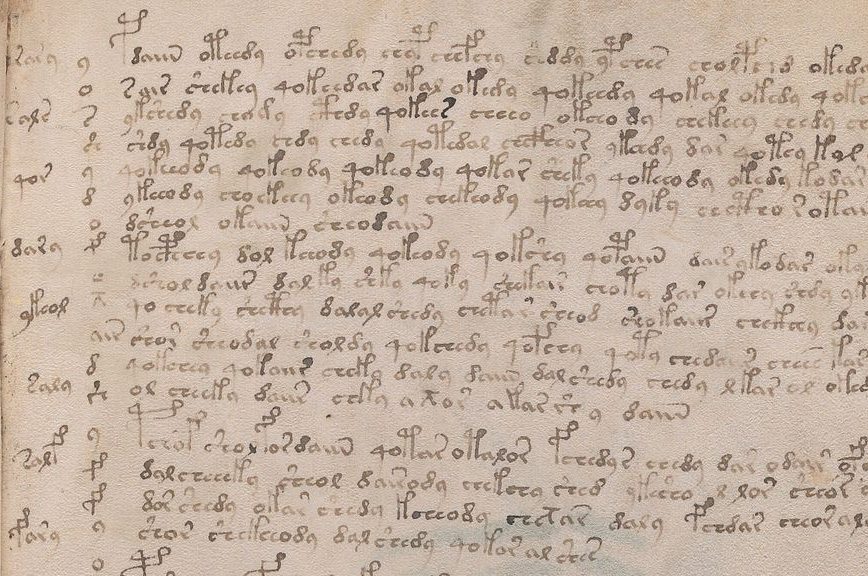
This is the strongest of all the versions that say there is no meaning. Torsten Timm and Andreas Schinner proposed a mechanism that needs neither a stencil, nor a table of syllables, nor a key. The scribe looks at a word already written beside him or a line above, and writes it again with a small change: a sign swapped, a prefix added, an ending dropped. Line after line, page after page.
The beauty of the idea is that it explains precisely those features that are usually produced as proof of meaningfulness.
Why the usual arguments against it do not work
Here is what autocopying reproduces of its own accord:
- Low entropy. A copy with a small change is predictable by definition.
- Zipf's law. The frequency distribution of words arises automatically under copying.
- Families of similar words. They are the direct product of the mechanism.
- The clustering of repeats. Words stick to each other because they are copied from nearby places.
From this follows a conclusion we regard as an important lesson in method: low entropy on its own does not rule out a hoax. Reviews that write "the entropy is too low, therefore this is not gibberish" are reasoning wrongly - a mechanical generator has exactly the same entropy.
To reject a version of this kind, one needs the features that the generator overshoots or undershoots, not the features it reproduces.
How we tested it: tuned on one part, compared on another
We built an autocopying generator and tuned it on part of the manuscript so that it would hit that part's statistics as closely as possible. We then compared its output against held-out windows of the text that it had never seen, and looked at six separating measures at once. The test plan was written down before the results were obtained.
The logic is this: similarity can be fitted, differences cannot. If the generator is right, it has to pass all six windows. It failed five of the six.
| Measure | Voynich manuscript | Autocopying generator |
|---|---|---|
| Pairs of twin words with different spellings | 42 | 0 |
| How many different words cover 80% of the text | 51 | 115 |
| Word-boundary effect | +0.197 | +0.014 |
| Clustering of repeats | 1.75 times above chance | 5.38 times, a heavy overshoot |
| Co-occurrence ratio R | 1.87 | 3.47, an overshoot |
Two rows are especially telling.
Twins with different spellings. The Voynich contains 42 pairs of words that behave identically but are written differently - the trace of a homophonic cipher, in which one unit can be written down in several ways. Autocopying does not create such pairs at all: it produces families of similar words, not of dissimilar interchangeable ones. Zero against forty-two.
The overshoots. The generator does not merely miss, it misses on the side of excess: its clustering of repeats is three times higher than the Voynich figure, and so is its co-occurrence. The real manuscript is more disciplined than mechanical copying, which means something inside it is working against repetition.
What this means
The version is rejected not because we dislike it, but because it failed on held-out data, on specific measures named in advance.
What follows from this is not that meaning has been proved, but something more modest: mechanical explanations have been tested and did not work. Together with the rejected Cardan grille this shifts the burden of explanation onto a substantive model - in our case a workshop homophonic cipher whose mechanism has been reconstructed.
It is worth adding that the argument about gibberish is alive in the academic world too: at the Malta conference on the Voynich, one and the same research group presented two papers that were each other's opposite, "Gibberish after all?" and "A cipher after all?". That is the normal state of the question, and our contribution here is not an opinion but a separating test with numbers.
The lesson in method
From this work we took away a rule that we now apply to everything: a hypothesis has to be rejected by a feature it is obliged to overshoot or undershoot, not by a feature it reproduces anyway. We later stepped on an adjacent rake ourselves in a different test and retracted our own conclusion in public: see the account of the East Asian version.
No decipherment of the Voynich manuscript exists. A coincidence is not a reading.
FAQ
What does the autocopying hypothesis say?
The scribe takes a word already written beside him or a line above, writes it out again with a small change, and so on line after line. No language and no key are needed for this, and the text that comes out looks like the real thing, with repeats and families of similar words.
Why can this version not be rejected with the usual arguments?
Because autocopying reproduces exactly those traits that are normally offered as proof of meaningfulness: low entropy, Zipf's law, families of similar words, the clustering of repeats. What is needed are features that the generator overshoots or undershoots.
What does "discriminative test" mean?
It means tuning the generator on one part of the text and comparing it on another, held-out part, and looking not at overall similarity but at specific separating measures. Similarity can be fitted; differences cannot.
So is there meaning in the Voynich manuscript?
Our checks say that mechanical explanations do not work: the grille and autocopying have both been rejected. That is an argument in favour of there being content behind the text. But the content itself has not been read, and we claim no reading.