Language claims
"The Voynich manuscript is Aztec." What is left of the Tucker and Talbert hypothesis
A botanist recognised 37 Mexican plants in the drawings, and minerals from Baja California in the paints. We read the laboratory report he relies on, and ran sixteenth-century Nahuatl through a structural filter.
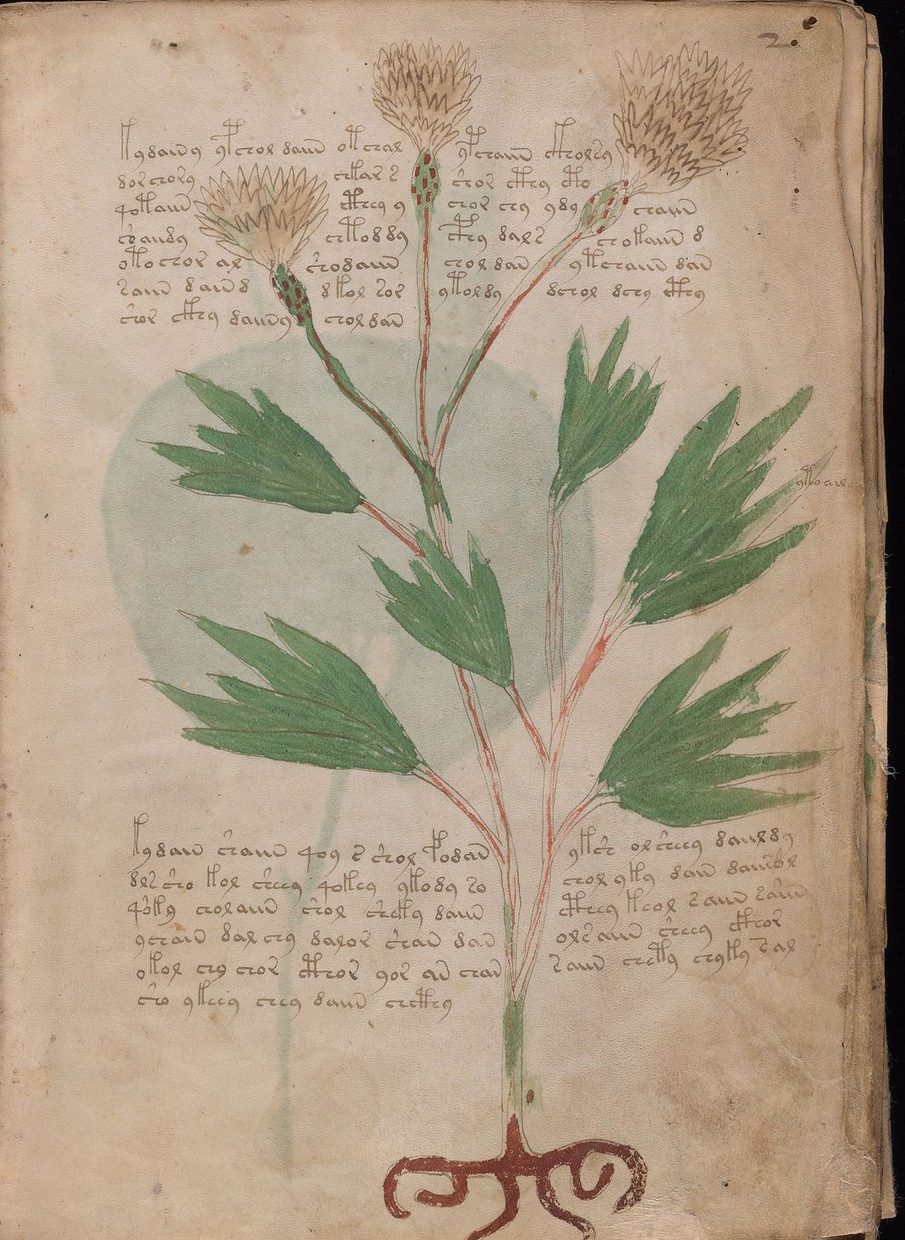
In 2013 the botanist Arthur Tucker of the University of Delaware and Rexford Talbert published a paper that still circulates in popular retellings as "the Voynich manuscript is finally solved". Their version: the book was made not in Europe but in sixteenth-century Spanish Mexico, the drawings show New World flora and fauna, and the text is written in one of the Aztec languages, most probably Nahuatl.
The version rests on four supports. We checked each of them - not by arguing, but by measuring and by reading the primary sources.
Support one: "New World minerals in the paints"
The strongest-looking argument is the material one. In retellings it goes like this: atacamite and boleite were found in the manuscript's inks, boleite is mined in Baja California, therefore the book is American.
Here there is something that can be checked literally, because a laboratory report exists. In 2009 Yale commissioned an analysis of the manuscript's materials from McCrone Associates - the very laboratory that once exposed the Vinland Map. The report was published by the Beinecke. This is what it says:
| What was examined | What was found |
|---|---|
| Ink of the text and the drawings | Iron gall, practically identical throughout the manuscript |
| Blue paint | Ground azurite with a small admixture of cuprite |
| Green paint | Copper resinate and copper chloride compounds consistent with atacamite |
| Red-brown paint | Red ochre |
| Overall conclusion of the report | The pigments are ground minerals whose recipes have been known since the Middle Ages; no component contradicts the radiocarbon date |
Atacamite really is in the report - and it proves nothing. Basic copper chloride was a standard European green: the recipe for making it artificially was written down by the monk Theophilus as early as the twelfth century, and it turns up in panel painting in Catalonia and Aragon and in Islamic manuscripts. What is more, atacamite forms on its own, with no painter involved: it is a product of the ageing and corrosion of copper greens, the same process that gives a copper roof its green coating. Finding it in a book painted with copper green is expected, not sensational.
Boleite is not in the analysis at all. Not in a single line of the report. In Tucker's work boleite belongs to a different department: it is a "geomorph", that is, the author looked at a drawn crystal on one of the pages and decided that boleite was depicted, and crystals of that quality are mined mainly in Baja California. This is recognition of a picture, not chemistry of a substance. It is also worth remembering that the mineral boleite was first described and named only in 1891, after the El Boleo mine.
The verdict on the first support: the material argument disappears once the primary source is checked. The popular formula "atacamite and boleite were found in Voynich ink" is a substitution: one of the two was found and means nothing, the other was not found at all.
Support two: the date
The radiocarbon analysis of the parchment, carried out at the University of Arizona, gives 1404-1438. America was reached in 1492. Nahuatl written in Latin letters appears only with the arrival of the Franciscan missionaries, that is, from the 1520s onwards: before that the Nahua used pictographic writing, not an alphabet.
The hypothesis requires New Spain after 1519-1521. That means the book would have to be written roughly a hundred years after the parchment was prepared. Such things happen - palimpsests and blank sheets were kept for decades - but then it has to be argued separately, and the authors do not argue it. On top of that, the dating does not rest on radiocarbon alone: the shapes of the numerals in the quire numbering and the parallel hatching technique are fifteenth-century markers, independent of the chemistry.
We put it carefully: the hypothesis pays with four independent pieces of evidence - radiocarbon, quire numbering, hatching style, the absence of Nahuatl written in Latin letters before the 1520s - in exchange for one botanical recognition.
Support three: the language. Here we were in for a surprise
We have our own instrument for checks of this kind. We reconstructed the mechanism of the Voynich cipher: a syllabic homophonic cipher in which the same unit of plaintext could be written in several interchangeable ways. The mechanism can be run: take a real text in a real language, pass it through the cipher model, and see whether the result matches the Voynich fingerprint.
We assembled a corpus of Nahuatl of the right period - not modern but colonial, from the sixteenth and the early seventeenth century: Nahua documents from Mexico City, the Annals of Tlatelolco, Chimalpahin's Eight Relations, the Cantares, Nican Mopohua. Almost a million characters, 135 thousand words.
The first run gave Nahuatl a resounding failure on the key measure, the share of twin words: 32% against 1.2% in the Voynich. It looked as though the version could be closed with a single number.
We did not do that - and we were right not to. Before writing the conclusion down, we checked that measure against every language we had run earlier. It turned out that the languages lined up strictly by file size: the fatter the source text, the more twins. Eight corpora out of eight, without a single exception.
The direct check: one and the same Nahuatl, cut into pieces of different lengths.
| Size of the source text | Share of twin words |
|---|---|
| 60 thousand letters | 2.1% |
| 120 thousand letters | 6.5% |
| 240 thousand letters | 12.7% |
| 480 thousand letters | 22.3% |
| 833 thousand letters | 30.5% |
The language is the same. Only the thickness of the book changes. The reason is simple: the larger the source text, the more rare words the output contains, words that occur two or three times; about such a word it is impossible to say honestly what surroundings it lives in, and a chance coincidence of neighbours gets counted as a pair of twins. The measure reflected the poverty of the data, not the structure of the language.
When we cut all eight corpora down to the same size of 57 thousand letters, the spread collapsed: Nahuatl gave 1.8% twins, Latin 1.4%, Middle Chinese 1.3% - all of them inside the Voynich target or right up against it.
The verdict on the third support came out double. The Aztec hypothesis is not rejected by the structural filter, but neither is it supported: the instrument does not distinguish languages under this cipher at all. Along the way we had to retract our own earlier conclusion about the East Asian version, where the ranking turned out to be the same artefact. There is a separate account of that: why the "Japanese sensation" and the Chinese version remain untested.
This is an unpleasant but honest result: we lost an instrument we believed was working.
Support four: similar letter shapes in the Codex Osuna
The fourth argument is that the shapes of the Voynich glyphs resemble the writing of the colonial Codex Osuna.
Here we already have a lesson learned. We tested a similar idea for Europe: that the Voynich signs are the standard notarial and scribal abbreviations of the fifteenth century. The result was a separating one: the shapes of the signs really are borrowed from the ordinary palaeography of the period, and the functions are not. The test of a concrete correspondence failed on frequencies: for example, a sign that ought to be read as a Latin ending occurs three to six times more often than that ending occurs in real Latin.
Hence a general rule: a coincidence of letter shapes says nothing about meanings. For the argument "the signs are like those in the Codex Osuna" to work, one needs a check of frequencies and positions - which signs, in which positions, and how often. The authors did not carry out such a check.
The upshot
| Support of the hypothesis | What the check showed |
|---|---|
| New World minerals in the paints | There is no boleite in the analysis; atacamite is there, but it is a standard European green and a product of ageing |
| A sixteenth-century date | Direct conflict with C14 1404-1438 and fifteenth-century codicology; the authors give no answer |
| The Nahuatl language | Neither rejected nor confirmed: the filter is blind to language. The instrument turned out to be unfit |
| Signs as in the Codex Osuna | A coincidence of form with no check of functions - the same class of argument we have already closed for Europe |
The hypothesis is rejected - but it matters what rejects it. Not "the language" and not "the statistics": the language decides nothing here. It is rejected by the dating and by source criticism - by the fact that when you read the report everyone was citing, what stands in it is not what they said.
And one more thing the popular retellings do not mention. The dispute over whether a given plant is Mexican or European is unresolvable in principle - not because the experts are poor, but because of the way the drawings are made. We measured the connection between leaf, root and flower on the Voynich pages: it is close to zero, the features are assembled like a construction kit. In Dioscorides, and even in a stylised contemporary of the Voynich, the herbal of Manfredi, the features are connected far more strongly. With combinatorial assembly, any specialist will see on the drawing the flora he knows best. More on this: chimeric plants as a defence against recognition.
How we tested this
The check is described in a plan pre-registered before the data were obtained; the script and the full protocol of measurements are open. The criterion "the version survives if Nahuatl fits no worse than Latin" was written down before the run, not chosen to suit the result. The corpus was assembled by the rule "data of the right period, not a modern surrogate": modern Nahuatl will not do for a hypothesis about the sixteenth century.
We propose no reading of the text and do not consider one possible: no decipherment of the Voynich manuscript is claimed, and a coincidence is not a reading.
FAQ
So what language is the Voynich manuscript written in?
Unknown. Our structural filter showed that under a cipher of this type the original language does not show through at all - Latin, Nahuatl and Middle Chinese leave the same trace. No method available to us can name the language, and any claim of the form "this is language X" has no evidential support today.
Does that mean the plants in the drawings are European after all?
We do not claim that. We measured something else: in the Voynich plants the leaf, the root and the flower are almost unrelated to each other (mutual information 0.206 against 0.716 in Dioscorides), which means the drawings are assembled combinatorially. With that kind of assembly, reliable identification of a species is impossible for Mexican and for European flora alike.
What did the analysis of the manuscript's inks and paints show?
The 2009 McCrone Associates report for Yale found this: the inks are iron gall, the blue is ground azurite with an admixture of cuprite, the green is copper resinate and copper chloride compounds consistent with atacamite, the red-brown is ochre. The report concludes that no component contradicts the radiocarbon dating of the parchment.
Is it true that boleite from the mines of Baja California was found in the paints?
No. There is no boleite in the laboratory analysis at all. In Tucker's work boleite is a "geomorph", that is, the identification of a crystal drawn on an illustration, not the result of an examination of matter. The mineral boleite itself was first described only in 1891.