Language claims
The Slavic bukvitsa and Sanskrit: why "one letter, one word" does not work
Two popular versions - that every Voynich sign is a letter-word of the old Slavic alphabet, and that the script is built like an Indian abugida. Both can be tested by simple counting, and both break on it.
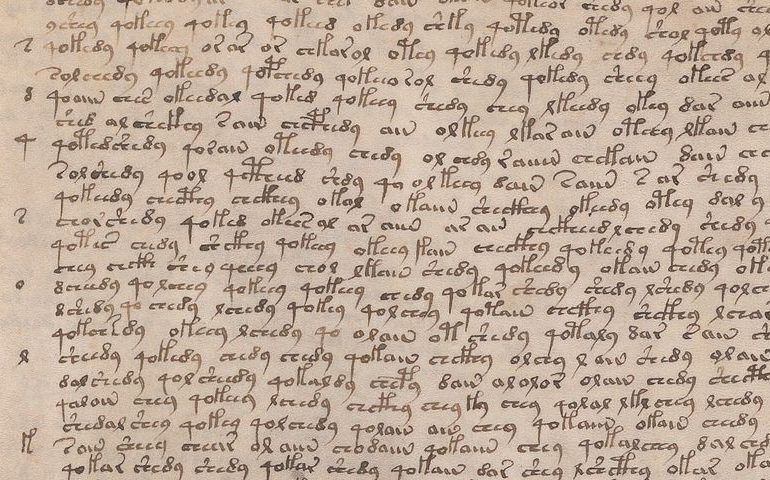
The idea that "every sign is a whole word" is very persistent, and it has an attractive support: the words of the Voynich manuscript are short, and the text itself looks uniform, as though it had been assembled from ready-made blocks. Hence the Slavic version - that what we have before us is an ancient alphabet of letter-words, the bukvitsa, in which each letter carries meaning on its own, and that there are 49 such letter-words in all. Beside it stands a second version, the Indian one: that Voynich writing is built like an abugida and the language is Sanskrit or a relative of it.
Both versions have the convenient property that they can be tested without reading a single word. It is enough to count.
Test one: how many signs are there
The Slavic version names an exact number - 49 letter-words. That is its strength: numbers can be checked.
In the main Voynich transliteration there are about 32 reliably distinguishable signs. The number drifts slightly depending on the parsing system - some rare ligatures can be counted as separate signs or as combinations - but in no variant of the parsing do we arrive at 49. The gap is too large to be put down to disputed cases.
Test two: word length
This is the main argument, and it requires no theory at all. If a sign equals a word, then words of one sign must be a mass phenomenon, as they are in any script where a mark carries meaning in full.
Counting across the whole text:
| What we measure | Voynich |
|---|---|
| Average word length | 4.47 glyphs |
| Share of one-sign words | 3.75% |
| Entropy per glyph | 3.86 bits |
| Number of different words covering 80% of the text | 1351 types |
The average word is four and a half signs long, and single-character words make up less than four percent. This is a structure in which a sign is part of a word, not a word. The version "one letter equals one word" breaks on this number, and no translation can save it here: one can argue about meaning, but not about length.
Where the "match with 49" came from
Our own work contains a number that is sometimes brought into this discussion: 80% of the Voynich text is served by about 56 semantic cores. It looks like 49, and the temptation is strong.
It is an illusion, and here is why. The number 56 was obtained after prefixes and endings had been stripped away: we decomposed words into prefix, root and suffix - three quarters of all the words in the manuscript are built that way - and counted the roots. Roots are not letters. Comparing 56 roots with 49 letter-words is the same as comparing the number of roots in Russian with the number of letters in the Cyrillic alphabet: quantities of different natures, and the closeness of the numbers means nothing.
Incidentally, the number of roots in the Voynich really is anomalously small in itself: for comparison, in Latin about 640 cores go into the same 80% of the text, in Finnish 1357, in English 225. But that is an argument for a closed table of codes, not for an alphabet with meaning in every letter.
Test three: the abugida and Sanskrit
The Indian version is tested differently. An abugida is a script of a particular build: the consonant sign carries an inherent vowel within it, while other vowels are attached to it by marks above and below. Such a script leaves a specific trace in the statistics: certain classes of signs are rigidly tied to positions relative to one another.
We ran the corresponding test. The trace did not appear: Voynich writing is not an abugida. With it falls the version "Sanskrit written in an Indian-type script" - not because Sanskrit is a poor candidate, but because the script is built differently.
Note the converse as well: the Voynich does have vowel-like signs. The alternation of vowel and consonant works as it does in Latin - by Sukhotin's classic measure the Voynich gives 0.771 against 0.785 for Latin and 0.598 for a random set. That is, the text is language-like, but in a European way, without the Indian machinery of marks above the line.
Why versions like these arise at all
This is the place to speak of the main trap of the whole field. The syllables of any language combine in a limited number of ways, and the Voynich text has about 37 thousand words. At that volume any language will yield dozens of recognitions: combinations that look like words, pretty coincidences, moments of "there it is". This is how the Persian, Arabic, Hebrew and Sanskrit readings arose - and all of them are most probably artefacts of combinatorics.
One rule saves you from this trap: structure first, meaning afterwards. If a version lays claim to a language, it is obliged to predict something measurable - the number of signs, word length, the build of the syllable, the statistics of combinations - and that prediction has to be checked before any translating begins. The Slavic and Sanskrit versions do not pass this check, and note that not a single word had to be translated in order to establish it.
What is left standing
From the Slavic version there remains a sound observation that we share: the Voynich text really is assembled from repeating blocks, and those blocks are few. Only they are explained not by an alphabet with meaning in every letter but by a closed table of codes: about 18 prefixes, some fifty roots, 18 endings - and 74% of all the words in the manuscript fit the scheme "prefix + root + ending".
This is our main result about the mechanism: how the cipher of the Voynich manuscript works. It explains the short words and the uniformity without requiring either letter-words or Sanskrit - and, unlike them, it reproduces the numbers of the manuscript.
No decipherment of the Voynich manuscript exists, and we claim none: a coincidence is not a reading.
FAQ
How many signs are there in the Voynich alphabet?
About 32 reliably distinguishable glyphs in the main transliteration, EVA. The exact number depends on the parsing system, but in none of them does it come to 49, the number of the Slavic bukvitsa.
Can each Voynich sign stand for a whole word?
No. If a sign were a word, short words would be commonplace and the average word length would be about one or two signs. In reality the average Voynich word is 4.47 glyphs, and words one sign long make up only 3.75 percent.
What is an abugida, and why is the Sanskrit version rejected?
An abugida is a script in which a consonant sign carries an inherent vowel while other vowels are marked by signs above and below it. Such a script leaves a characteristic trace in the statistics of sign combinations. The Voynich has no such trace: the test showed that the script is not an abugida.
But what about the match with the 56 roots that people write about?
That is an illusion. The number 56 was obtained after prefixes and endings had been stripped away - these are roots, not letters. Comparing them with 49 letter-words is like comparing the number of roots in Russian with the number of letters in the Cyrillic alphabet.