Calendar and zodiac
A zodiac by degrees: the one external signal, and how we limited it ourselves
The nymphs in the Voynich rings matched an astrological table of masculine and feminine degrees in al-Biruni at a shift of 23 positions. We tested it blind, replicated it - and then showed ourselves that the signal is not universal.
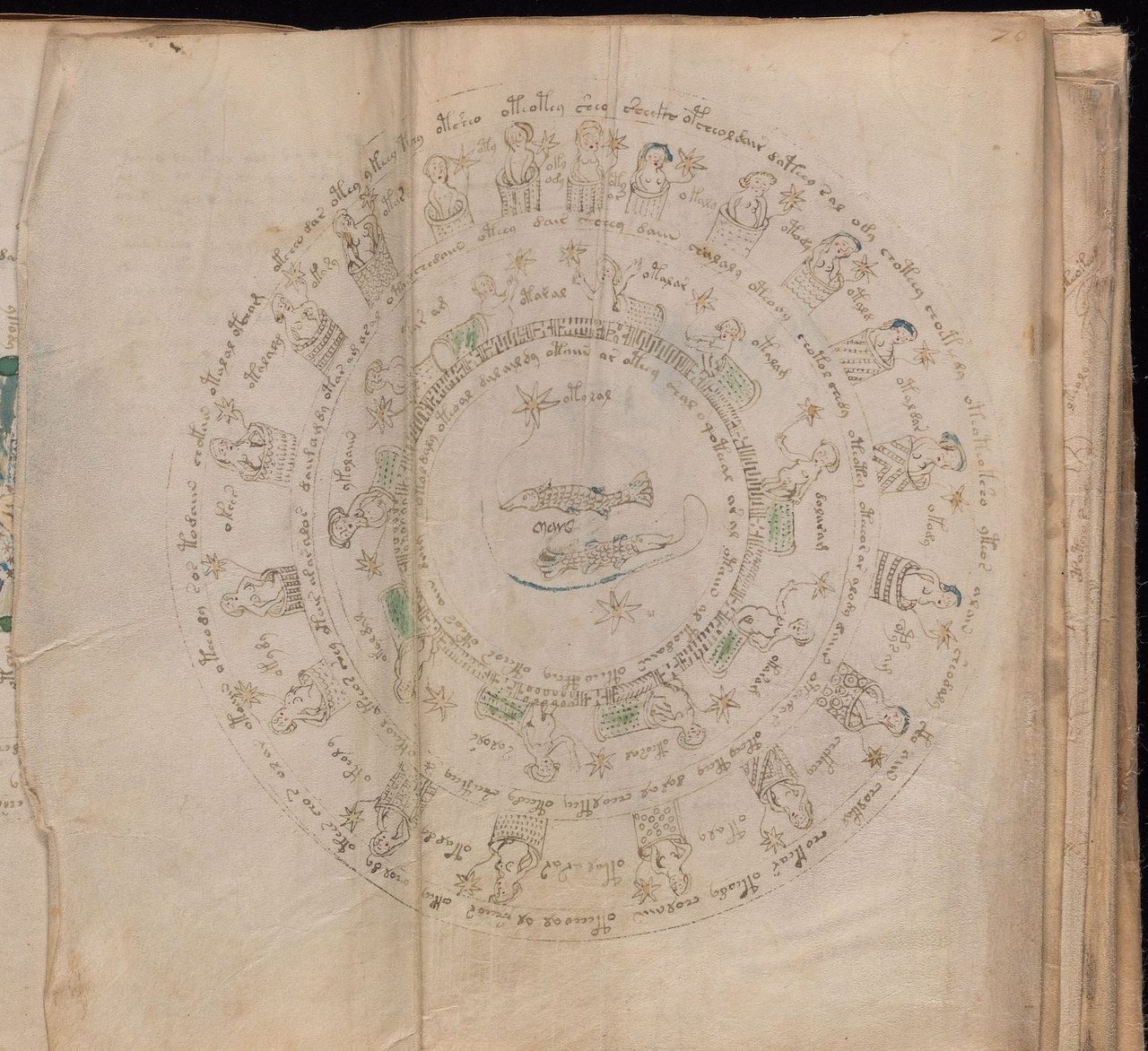
The zodiac pages are the most structured part of the Voynich manuscript, and it is here that we have our one match with an external source that survived a blind test. It is also here that we showed the limits of that match ourselves. This article is about the finding and about its boundary alike.
The rings are a list of thirty positions
First the frame. Around each sign of the zodiac stand figures of women, the "nymphs", and beside each of them a short label. There are about thirty positions per sign.
For a long time these were taken for days and church calendars were searched for; that line ended in an instructive failure, described in the false match with the Lleida calendar. A test that does not depend on the key showed that the rings behave like degrees of the zodiac, thirty to a sign, and not like days.
Lists by degree are an astrological genre in their own right. One of them produced the signal.
Masculine and feminine degrees
In medieval astrology every degree is assigned a quality, masculine or feminine. The table is found in al-Biruni, in section 457 of his handbook, and through Alcabitius it was known to Latin Europe, so a fifteenth-century author had access to it.
We matched this table against a feature of the figures in the Voynich rings and obtained a match with the list shifted by 23 positions.
How we tested it blind
The temptation to see what one wishes to see is enormous here, so every test followed a blind design. The images were cut into separate frames, anonymised and shuffled. They were coded by a person who did not know the hypothesis being tested, following a criterion described in advance. The comparison with the table was made only after the coding.
The key round gave a match of 52 out of 78 at a shift of 23, p = 0.0088, and the profile of matches had its peak exactly at 23 - at the shift that had been named beforehand.
We then tested specificity, that is, whether just anything would give a similar result:
| Control source | Result |
|---|---|
| The neighbouring table in al-Biruni (section 458) | Zero, as predicted in advance |
| The images of the Astrolabium planum of 1488 | Zero |
| The feature taken from the label itself instead of the drawing | Zero (p = 0.505) |
| The stars beside the figures against a different table | Zero (p = 0.62) |
The signal is specific: it holds on to one particular table, not to "any list of 360 elements".
How we limited the finding ourselves
Next came the most useful part of the work: the attempt to extend the signal to the remaining signs of the zodiac.
It failed. Blind rounds on the signs from Cancer to Sagittarius gave a complete zero. What is more, the check showed that on those signs all the figures are unclothed - the feature the signal rested on is simply not observable there, because clothing turned out to be a constant rather than a variable.
The conclusion we wrote down against ourselves: the signal is local. It exists for Pisces, Aries and Taurus - the signs whose figures are drawn standing in barrels - and it does not extend to the zodiac as a whole. The handsome reading of "the whole zodiac by degrees" has been withdrawn.
There were nine blind rounds in all: dress, headgear, the fill of the star, sex, the turn of the body, the pose of the arms. Most of them gave honest zeros. We do not hide them - they are precisely what determines the worth of the result that survived.
The labels are not names but abbreviations
In parallel we were working out what is actually written beside the figures.
The labels behave like an inventory of names, not like connected speech: the share of unique words among them is 0.77 against 0.20 in ordinary paragraphs. Each ring is a list of its own, and the overlap between rings is close to nil.
But full names they cannot be. We tested the capacity: a full name physically does not fit into a label, and they are not numerals either - a version we rejected in four different ways. The most likely model is a two-letter siglum, that is, an abbreviation, plus a functional class marker. In two thirds of cases the label begins with one and the same sign, which works as a note saying "this is a name".
Put differently, a ring is a sigla-marked list of twenty-odd names over thirty positions. It cannot be read: an abbreviation cut down to two letters is unrecoverable without an external list, and we searched for such a list across nine classes of sources and did not find one.
An unexpected detail: rings that run against the flow
A separate line of work concerns the direction the figures are turned in. A blind recoding of 146 figures showed that on fourteen rings the figures are turned along the direction of movement, while on two - the inner ring of Pisces and the inner ring of the dark Aries - they are turned against it, 10 out of 11 and 4 out of 5 respectively. Both of these rings sit on the same opening of the manuscript, and they are the same signs that produced the main signal.
What this means we do not yet know. A test on the next group of signs has been prepared and is waiting to be coded.
Status
We keep this line open rather than closed. The grounds are a blind replication with specificity. The limitation is the locality of the signal and the impossibility of reading the abbreviations.
No decipherment of the Voynich manuscript exists, and the zodiac signal does not supply one: it speaks about the structure of the page, not about the content of the text. A coincidence is not a reading.
FAQ
What are masculine and feminine degrees?
In medieval astrology each of the 360 degrees of the zodiac is assigned a quality, masculine or feminine. The table appears, among other places, in section 457 of al-Biruni's handbook, and it recurs in the Latin tradition by way of Alcabitius.
What does a shift of 23 positions mean?
The match showed up not under a direct overlay but with the list shifted by 23 positions. This may reflect a different starting point for counting the degrees. What matters is that the shift was fixed in advance, and that in a repeat blind test the peak fell exactly on it.
Why is the test called blind?
The images were coded by a person who did not know which hypothesis was being tested, following a criterion described in advance, on shuffled and anonymised frames. That is how fitting to an expected answer is excluded.
Does that mean the Voynich zodiac has been deciphered?
No. The signal is local: it holds for three signs and is not confirmed on the rest. The labels, meanwhile, cannot be read - by our measurements they are two-letter abbreviations of names, into which a full name physically does not fit.