The botanical route
Chimeric plants: why botanists see different species on the same page
The Voynich plants are assembled like a construction kit, the leaf from one species and the root from another. We measured this in a blind experiment and compared the result with a real herbal and with a stylised contemporary of the manuscript.
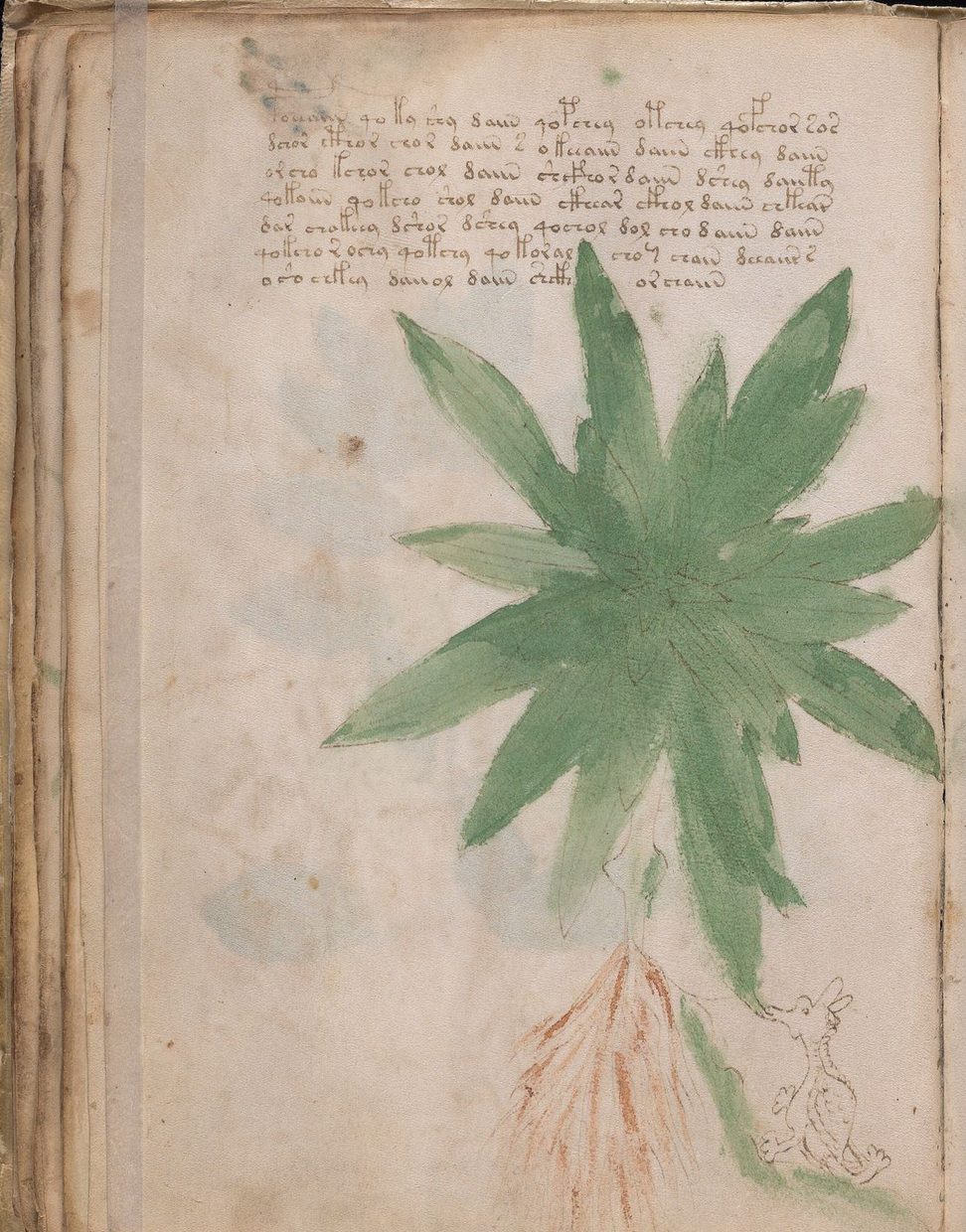
The argument about the Voynich plants has been running for a hundred years and always to the same pattern: a specialist looks at a page and names a species. Another specialist looks at the same page and names a different one. Both are confident, both are competent. Some see European henbane, others a Mexican sunflower.
We decided not to take part in the argument but to explain it. The hypothesis is simple: the problem is not with the experts but with the way the drawings are built.
What we measured
If an artist draws from life, the features of a plant are connected to one another: from the type of leaf one can predict, with some confidence, the type of root, and from the flower the structure of the stem. Nature does not combine them arbitrarily.
If, on the other hand, a drawing is assembled from ready-made parts, that connection weakens: any leaf may end up attached to any root.
The connection between features is measured by mutual information. This is not a judgement of "looks like it" or "doesn't", it is a number.
How the experiment was set up
The plan was written down in advance, before any coding, so as to exclude fitting. The coder was a person who did not know which hypothesis was being tested and worked blind: he was given a deck of 64 cards with plant drawings from three sources shuffled together, and marked the type of leaf, the type of root and the type of flower on each card.
The three sources:
- the Voynich manuscript - the object of study;
- Dioscorides - the classical herbal, whose drawings go back to drawing from life;
- the herbal of Manfredi - a stylised herbal of the Voynich period. This is the key control: it shows what the connection between features looks like in a conventional, crude, schematic drawing of the same time.
The result
| Source | Mutual information between features |
|---|---|
| The Voynich manuscript | 0.206 |
| The herbal of Manfredi (a stylised contemporary) | 0.478 |
| Dioscorides | 0.716 |
The difference between Dioscorides and the Voynich is significant at p = 0.0068. The difference between Manfredi and the Voynich is significant at p = 0.0254.
The second number matters more than the first. It closes off the main objection, that the Voynich has a low connection simply because its drawings are conventional. Manfredi is conventional too, and his features are still more than twice as strongly connected. The low connection in the Voynich is not an artefact of crude drawing but a sign of combinatorial assembly.
What follows from this
First, the century-old argument about species gets an explanation. Under combinatorial assembly, every specialist completes the whole from the parts he recognises and sees the flora he knows best. The argument is unresolvable, and not through any fault of those arguing. The same applies to the Aztec version with its 37 Mexican plants: the identification there rests on the same unreliable channel.
Second, the botanical route to a reading is closed. If the species of a plant cannot be established reliably, then its name cannot be used as a hint to the text either: see Bax's route.
Third, and this is the most interesting part, the structure of the drawings turns out to be the same as the structure of the text. Three quarters of Voynich words are assembled to the scheme "prefix plus root plus suffix" out of a small set of elements. The plants are assembled the same way: out of a small set of leaves, roots and flowers. One and the same combinatorial principle in two different materials.
What we do not know
Here we are obliged to stop and name the open question.
A low connection between features is explained equally well by two different things:
1. A defence against identification. The drawing is deliberately made so as not to serve as a hint to the enciphered text. 2. The modelling of crossings. The artist was depicting not existing plants but combinations - for example, ideas about where cultivated varieties came from.
They can be told apart: breeding predicts clusters of recurring combinations of "parental" features, while a defence against identification predicts uniform independence. We have the data for such a test, but not much of it - the 64 cards include only 20 Voynich pages, and the power of the check is low.
We state the caveats on the whole piece of work plainly: there was one coder, the significance passes a strict correction for two comparisons only marginally, and the coding noise is around half. This is a result at the level of "supported", not "proved".
Why we value it
Out of the whole recent wave of our checks this is the one positive result. Everything else consists of honest zeros: versions rejected, routes closed, our own conclusions retracted. That proportion is what research looks like when the answer is not being fitted.
No decipherment of the Voynich manuscript exists, and we claim none: a coincidence is not a reading.
FAQ
What does "chimeric plant" mean?
A plant assembled from the features of different species: the leaf of one, the root of another, the flower of a third. On the drawing it looks like a coherent whole, but no such species exists in nature.
How can this be measured rather than merely asserted?
Through the mutual information between the features. If the drawings are made from life, then the type of leaf lets you predict the type of root - the features are connected. If a drawing is assembled combinatorially, the connection is weak. We had the features coded blind and computed the connection.
Why does the herbal of Manfredi take part in the comparison?
It is the control for stylisation. One could argue that the low connection in the Voynich is simply a consequence of crude, conventional drawing. Manfredi is a stylised herbal of the same period, and in it the features are connected markedly more strongly than in the Voynich. So the matter is not one of style.
Why would an artist assemble plants out of other plants' parts?
There are two explanations and we have not yet told them apart. The first: this is a defence against identification, so that the drawing cannot serve as a hint to the text. The second: a depiction of crossings, that is, an attempt to model something. We have designed a test that would separate them, but there is little data for it.