Hoax and gibberish
The Cardan grille: testing the hoax version without arguing about taste
Gordon Rugg showed that a text resembling the Voynich can be generated with a table of syllables and a piece of card with slots cut in it. We tested not the plausibility of the idea but its physical trace on the pages - and did not find it.
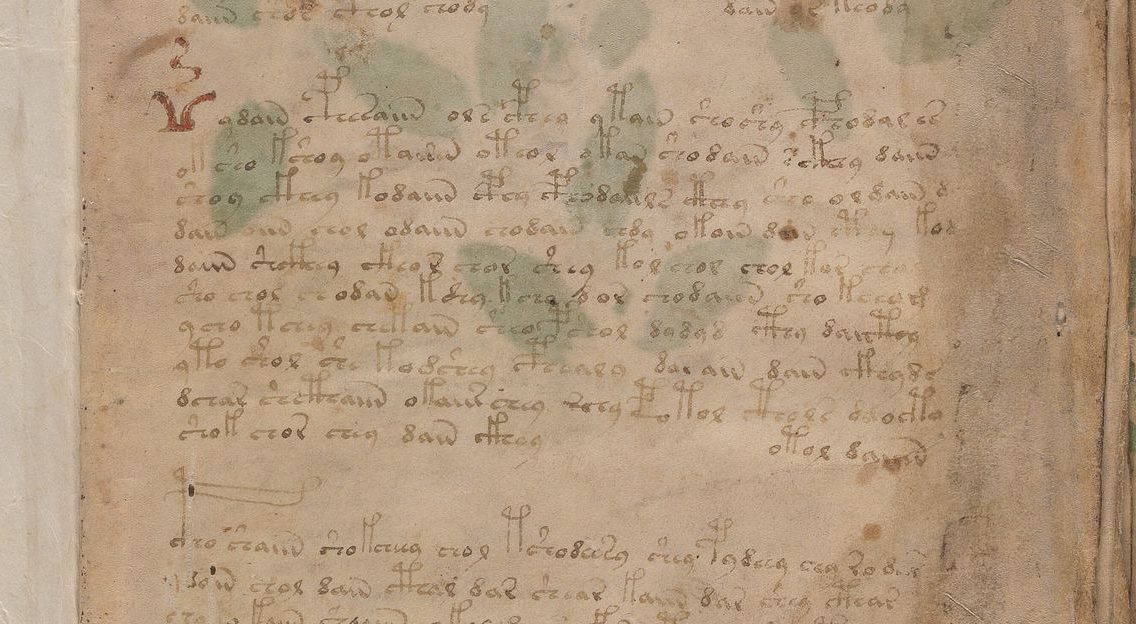
The hoax version is the most economical of them all: if the text means nothing, there is nothing further to explain. In 2004 the medievalist and methodology specialist Gordon Rugg put it in its strongest form. He took a table of syllables and a card with slots cut in it - a device known since the sixteenth century as the Cardan grille - and showed that a text outwardly resembling the Voynich can be produced this way, and produced fast.
The argument was a serious one, and it cannot be dismissed with a matter of taste, with "it doesn't look like that to me". What is needed is a measurable trace.
Why low entropy settles nothing
First let us clear away an argument that keeps turning up in popular reviews: the Voynich text is too orderly, its entropy is too low, therefore it is not random gibberish.
The argument is wrong. The conditional entropy of the Voynich text really is anomalously low, around 2 bits, against 2.96-3.23 for natural languages. But mechanical generators produce exactly the same low entropy, and Rugg's grille is one of them. Repeating blocks drawn from a table make a text predictable as a matter of course. Ruling a hoax out by that one number is a logical error, and we dwell on it deliberately, because it turns up even in reviews written in a confident tone.
What is needed, then, are features that separate a meaningful source from a generator, rather than features that merely show the text to be odd.
Trace one: the text itself
Our first check went through the statistics of the text: does a grille generator reproduce the whole bundle of Voynich numbers at once - word length, the "prefix plus root plus suffix" build, the distribution of repeats, the behaviour of neighbouring words in a line?
The answer is that it does not. A table-driven generator gets close on one or two measures and misses on the rest. This is what one would expect: the Voynich word is built too regularly for random insertion through a stencil. Three quarters of all words fit the prefix, root and suffix scheme, and there are only about 56 roots covering 80% of the text.
Trace two: the geometry of the page
The second test is the more interesting one, because it does not depend on any linguistics at all. It tests the physics of working through a stencil.
If a scribe slides a grille across a sheet, dropping blocks into the slots, then conspicuous elements ought to fall at a roughly constant step. The Voynich has ideal markers for a check of this kind - the gallows glyphs: tall signs with looped ascenders, visible on a scan from across the room.
We marked up their positions on the pages and measured the spread of the distances between neighbouring gallows. If the work had gone through a stencil, the spread should be noticeably smaller than chance, because the slots set the step. The measured coefficient of variation is 0.89, which is practically indistinguishable from a random arrangement.
| What the grille predicts | What was measured |
|---|---|
| A regular step between conspicuous glyphs along the line and down the page | Spread of the gaps 0.89, the chance level |
| A match on the whole bundle of textual measures at once | A match on part of the measures, a miss on the rest |
Two independent checks, one textual and one geometric, both came out zero. The version has been rejected twice over.
Who could have forged it
The chronology is worth keeping in mind too. The classic suspects are Edward Kelley, John Dee's associate, and Wilfrid Voynich, who bought the manuscript in 1912. The radiocarbon date of the parchment, 1404-1438, leaves room for neither: both lived considerably later. A fifteenth-century forgery is conceivable as well, but then the motive disappears, since the market in curiosities that would have made the effort worthwhile took shape a great deal later.
What is left of the idea that this is gibberish
The idea itself does not end with the grille. There is a subtler variant, in which the scribe used no stencil at all but copied and slightly altered what he had already written, generating text without content. We tested that version separately and rejected it too, but by a different, discriminative route: see autocopying after Timm.
And one more observation, which matters for honesty. The Voynich text contains a stratum of short formulaic openings that look like filler. We tested that too: the bimodality is real, but the suspicious part of the text turned out to be more coherent than the rest, not less. It is not filler but a layer of formulas, the equivalent of "take", "mix" and "add" in a book of recipes.
What this changes in the overall picture
Rejecting the hoax is not the same as saying the book is certainly full of meaning. It says that mechanical explanations have been tested and did not work, and that the structure of the text will therefore have to be explained by a substantive model. Ours is a workshop homophonic cipher, a model in which the mechanism has been reconstructed and the key is lost.
No decipherment of the Voynich manuscript exists, and we claim none: a coincidence is not a reading.
FAQ
What is a Cardan grille?
A sheet with slots cut in it, laid over the writing surface. Elements from a table prepared in advance are written into the slots, and then the grille is moved along. The device has been known since the sixteenth century. Gordon Rugg suggested that a meaningless but plausible-looking text like the Voynich could have been produced quickly this way.
So was the hoax version refuted by the low entropy of the text?
No, and this is a common error in review articles. Low entropy is reproduced by the grille and by other mechanical generators just as well - on its own it does not rule a hoax out. Versions of this kind have to be rejected by discriminative features, not by a single number.
How can a grille be tested when the grille itself is long gone?
By its trace on the page. Working through a stencil leaves a geometric periodicity behind: the conspicuous tall glyphs ought to fall at roughly equal intervals. We measured the spread of the distances between such glyphs on the scans, and it turned out to be practically random.
Who was suspected of the forgery?
Most often Edward Kelley, John Dee's associate, and less often Wilfrid Voynich himself. But the radiocarbon date of the parchment, 1404-1438, leaves no room for either of them: both lived considerably later.