The botanical route
"The first word is the name of the plant." Why the most sensible route did not work
The idea looks flawless: identify the plant in the drawing, find its name in the caption, and you have the first letters of the alphabet. We tested that channel in four ways. All four came out zero.
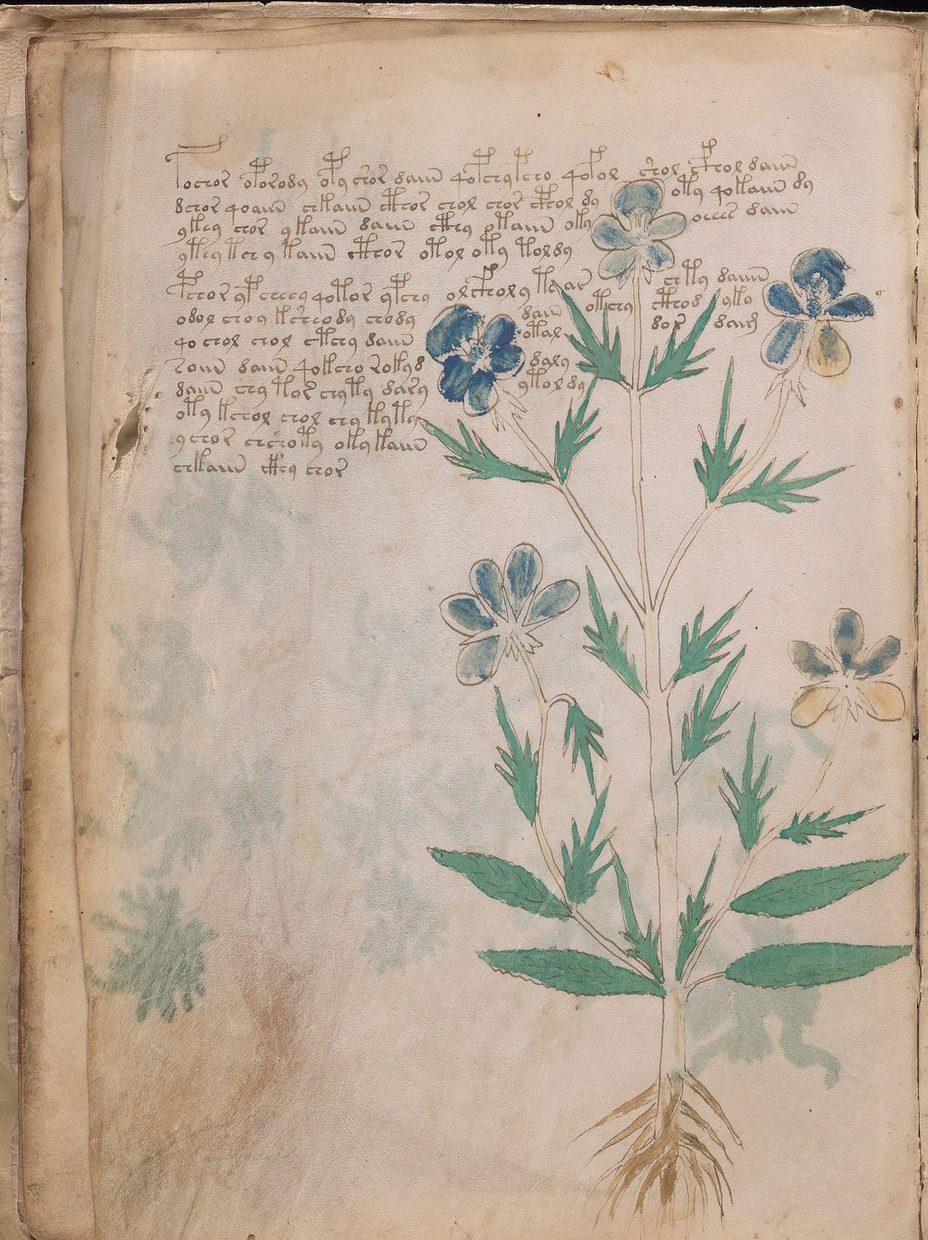
Of all the routes into the Voynich manuscript this one looks the most level-headed. It was argued for by the linguist Stephen Bax, and the logic runs like this: there is a plant drawn on the page; if we identify the species, we know what it was called in the medieval herbals; the name ought to be somewhere in the text of the page, most likely in the first word or in a caption. That gives us a few letters, and from there the alphabet unwinds by itself.
This is a classic crib, a fragment of known plaintext used to break a cipher. It is how most historical systems have been broken. We took the route seriously and tested it in four independent ways.
Test one: the name in the first word
The most direct version: the first word of the page is the name of the plant.
We took the pages whose plants are identified with more or less agreement among specialists, took their historical names, and checked whether there is any systematic relation between the name and the first word of the page. There is none: the similarity between the opening words and the list of names is no different from what a random assignment of names to pages produces.
Test two: the name somewhere in the first line or the opening words
Perhaps the name does not stand strictly first. We widened the window: the whole first line, then the first few words of the paragraph.
The result was the same. We checked the relation between two distance matrices, one between plant names and one between page texts: if the name is in there somewhere, similar names ought to give similar openings. The correlation is around zero. Separately we tested acrophony, the idea that the name is encoded in initial letters: the values sit at the edge of chance, with nothing resembling a signal.
Test three: the names ought to be rare outside the herbal
There is also an indirect check that requires no plant identification at all. If some of the words in the herbal are plant names, they ought to be tied to the herbal: they have no business in the sections about stars or about bathing pools.
We looked at how the candidate names behave. They occur quite comfortably on non-botanical pages: 18% of them, against the zero share that a genuine inventory of names gives in 76% of cases. That is the behaviour of ordinary vocabulary, not of a list of names.
Test four: sound similarity with the ancient names
Finally, we tested the idea of sound similarity itself: if the Voynich signs convey sounds, then plant names that sound alike ought to give similar chains of signs. The similarity value came out at the level of noise. The combined channel across all the matching cases also gave zero.
| Channel | What was tested | Result |
|---|---|---|
| First word | The plant name in the first word of the page | Zero |
| First line and first k words | Relation between distance matrices, acrophony | Correlation around zero |
| Tie to the section | Candidate names outside the herbal | They behave like ordinary vocabulary |
| Sound similarity | Similar names, similar chains of signs | Noise |
An important caveat about what we did NOT prove
Here honesty about statistical power is required. In the whole botanical section, across 129 pages, only 6 free-standing labels are marked up. That is vanishingly little.
Because of this, some attractive questions turned out not to have been "tested and rejected" but to be untestable on the available data. For instance, whether there is a link between the herbal and the zodiac rings through shared names: we do not know and cannot know, because there is nothing to compare. What we rejected is the specific name channel, not any link between the sections.
We consider caveats of this kind obligatory. The difference between "we looked and found nothing" and "there is nothing to look with" is a matter of principle, and popular retellings erase it as a matter of routine.
Why Bax's route could not have worked in principle
There is a deeper reason than the failure of the particular tests.
A crib requires that we know a fragment of the plaintext. Here that role is played by the name of the plant - but to know the name, the species has to be identified correctly first. And the Voynich drawings are built in such a way that reliable identification is impossible: leaf, root and flower on them are almost unrelated to one another, the features are assembled combinatorially. We measured this in a blind experiment: see chimeric plants.
The result is a closed circle: to read the text you need the species of the plant, and to determine the species you need the text. This is the Bax barrier, the boundary at which every botanical approach has come to a halt, and our work has done no more than establish exactly where it lies.
What is still alive
The pharmaceutical section of the manuscript is built differently: there a short caption stands beside each object drawn, and there are more than two hundred such captions. That is a genuine inventory: the share of unique words among the captions is 0.77 against 0.20 in ordinary text, a dictionary of names rather than connected speech. There the correspondence between caption and object can and should be tested, and that is what we are doing by counting the vessels and fragments that are drawn.
The route of "the plant name as a crib", however, has been falsified. No decipherment of the Voynich manuscript exists: a coincidence is not a reading.
FAQ
What was Bax's method?
Identify a real plant in the drawing, take its historical name, and look for something that sounds like it in the text on the same page, first of all in the opening word or in a caption. That was meant to yield a few reliable signs, and from them the alphabet would unwind.
Why did the method not work?
The name of the plant does not survive in the text of the page in any of the places we checked. Neither the first word, nor the first line, nor the first few words are any more closely tied to the plant name than random pages are.
Could the plants simply have been identified wrongly?
That is a separate problem, and a more serious one. The features of Voynich plants are almost unrelated to one another: the drawings are assembled combinatorially. With that kind of assembly, reliable identification of a species is unreachable in principle.
Does that mean the herbal section has no captions at all?
Almost none. In the whole botanical section, across 129 pages, there are only 6 free-standing labels. That is exactly why many checks in the herbal did not simply fail - they turned out to be impossible on the available amount of data.