What is established
Lines remember each other: the cycle d → q → y and a constraint on a whole class of explanations
The first word of a line in the manuscript avoids the first word of the previous line, and the openers have a directed cycle. We measured this on two transliterations, cross-checked it by re-flowing the lines and ran it through sixteen generators. Nobody carries it - ourselves included.
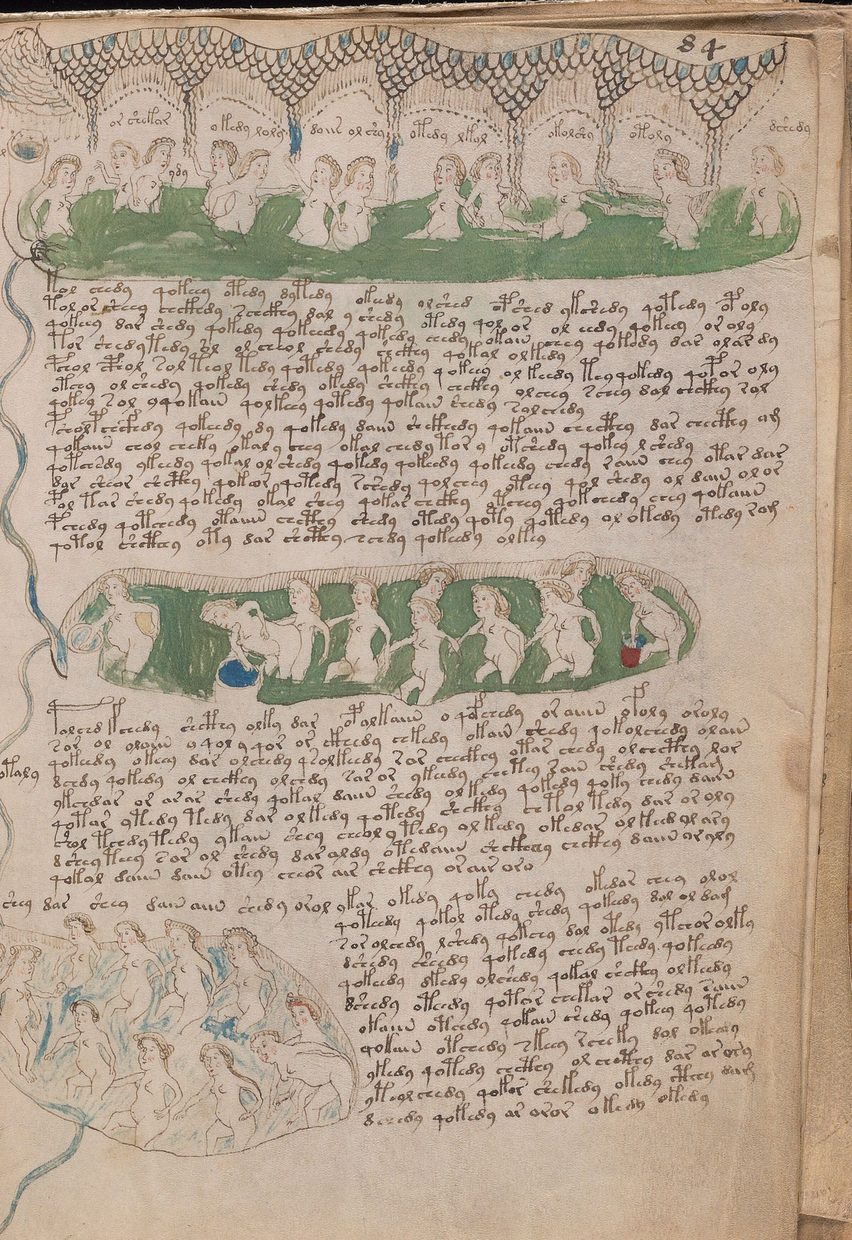
In August 2026 a claim appeared on one of the forums: someone had measured that the first words of neighbouring lines in the manuscript are linked to each other "with z around 25". No code, no paper, no data. We did not wait and made our own measurement - with our own definition, our own controls and a preregistration before the data. The corridor agreed. And then the story went where we did not expect.
Avoidance
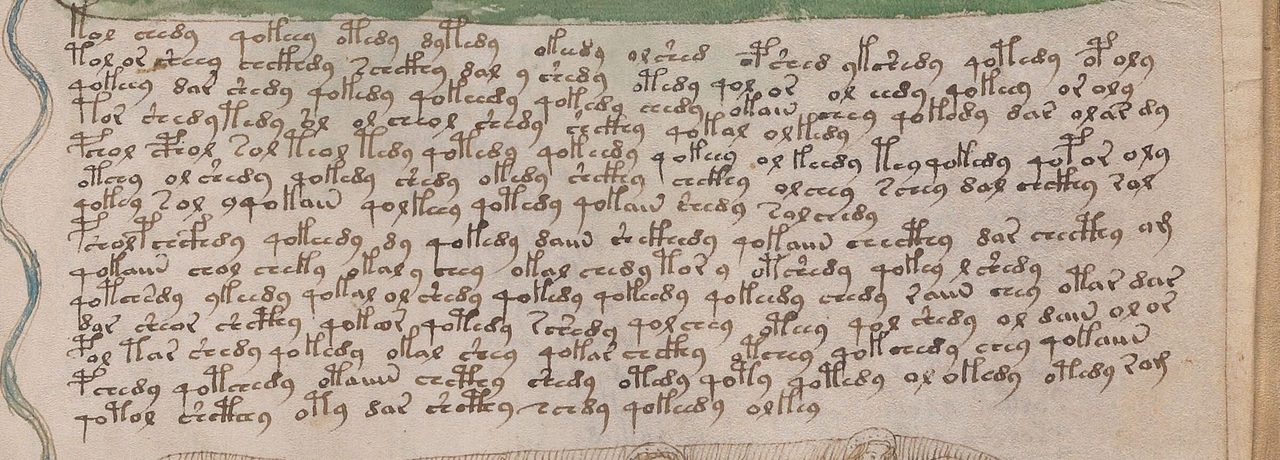
The definition is simple. The opener is the first glyph unit of the first word of a line. The measure is the mutual information between the opener of a line and the opener of the next line within a page. The null: openers shuffled within the page, ten thousand times.
The manuscript: 0.1683 against 0.0599 for the null, z +23.95. The independent Takahashi transliteration: z +24.17. The direction is avoidance: the same opener on neighbouring lines occurs in 6.88 % of cases against 13.54 % expected. The scribe does not start a line the way he started the previous one.
Controls. Without the first lines of paragraphs - z +22, so this is not an effect of the heading line. Line ends - z +1.16, p 0.13: specific to openers. Cato's Latin broken into lines - +0.95, the bench is clean. Power: with a planted effect of 5 % the bench catches it 20 times out of 20, with false positives 0 out of 20.
Language A gives z +16.8, language B +16.5 - in unison with the general rule "A is stricter than B".
Not only a ban
The next question: is this merely a ban on repetition, or are there preferences between different openers? We removed the diagonal - the "same opener" pairs - and counted again. Mutual information without the diagonal 0.3197 against 0.2307, z +19. There are preferences. The effect is local: at lag 1 it is huge, at lag 3 almost zero (+1.78), at lag 4 zero. It is visible at the level of sign classes too - "gallows", "benches", the rest (z +15).
And the first unpleasant result for our model: the generator gives 5 % of the effect. It has no inter-line link by construction - every line starts from a clean slate. The Naibbe cipher does not carry it either (z −1.6). This is a defect of the class of verbose models, not of our implementation. We entered it into the limitations of the first paper on the day of measurement.
The cycle d → q → y
In October a direction was added to the picture. If a line begins with d, the next more often begins with q; after q - with y; after y - with d again. The share of "forward" steps around the cycle is 0.629 at a null of 0.498, z +5.8, on two transliterations; for the two main hands of the manuscript z +3.8 and +3.7 separately.
The cycle is directed - that is its value. Avoidance of repetition can come from any habit. Direction requires the scribe to remember not only "not like the previous one" but "after this one, that one".
The re-flow check
Jorge Stolfi, one of the longest-serving researchers of the manuscript, proposed a control that we adopted at once: what if the lines are simply a cutting of a continuous stream, and all the "inter-line" effects are artefacts of where the breaks happened to fall? The check: re-flow the text with shifted line breaks and measure again. We showed the power of the control in advance.
Re-flowing kills the cycle completely: z drops from 6.0 to −0.7. Avoidance behaves the same way. So the effect belongs to the line as a unit of writing, not to the stream. The scribe saw the line and thought in lines.
Nobody
The most interesting part is the run through the catalogue. We have sixteen rival generators - the self-copying of Timm and Schinner, Cardan grilles with and without a period, a volvelle, templates, two-stage schemes, Markov chains over characters and over words, architectures with memory, Sachek's generator - and our own canon.
The cycle d → q → y is carried by none of the fifteen mechanisms in the catalogue. Our canon - 9 seeds out of 10 give |z| below 2. The magnitude of avoidance is taken by self-copying (83 % of the target) - by vertical copying, not by position; the grille with a period overshoots by 8.6 times. But the directed cycle - nobody.
We tried to repair the canon: add a table of opener preferences. Random tables give no cycle (z no higher than +1.3). One of ten permuted tables gave z +3.63 - and we were ready to rejoice, until we computed the mean over ten permutations: −0.5. That was the luck of a permutation, not a mechanism. A strong opener habit gives a cycle of random sign; the manuscript's cycle requires its directions. There is no candidate, and we are not fitting one.
What this means
The wording is careful, and we keep to it. This is not a "third layer of meaning" - we withdrew that in September, when it turned out that the other inter-word effects are reproduced by a simple chain. It is a constraint on the class of explanations: a generator that claims to be the manuscript must produce avoidance of openers with preferences and a directed cycle d → q → y, both of which vanish on re-flowing. Of the sixteen tested, not one does.
We have two such quantities: this one and the positional choice of form within a line along Morgallet's axis. Both concern the line as a unit of writing. Both await a mechanism.
A reading of medium confidence: vertical discipline in the scribe, a relative of the first-word effect of the line. Not a property of the plaintext - Latin broken into lines does not give it. Success would be finding a manuscript of the period in which a scribe behaves the same way; then this would become a mark of a school of writing.
FAQ
What is a line opener?
The first glyph unit of the first word of a line. It has long been known that the first words of lines in the manuscript are built differently - they begin with a "gallows" in 22 percent of cases against 8.5 in mid-line. We asked whether the openers of neighbouring lines depend on each other.
How was it checked that this is a property of the real line and not of the text stream?
By re-flowing. If the lines of the manuscript are an arbitrary cutting of a continuous stream, shifting the line breaks should change nothing. It kills the cycle of openers completely - z drops from 6.0 to −0.7. So the effect belongs to the line as a unit of writing.
Why does this matter more than one more defect of the model?
Because an ordinary defect is our own mistake, which someone else's generator may not have. Here the quantity is carried by none of the fifteen mechanisms tested - not self-copying, not grilles, not chains, not our canon. Any future model of the manuscript must explain it.
What might it mean?
A reading of medium confidence: vertical discipline in the scribe - a habit of not starting a line the way the previous one started, akin to the already known first-word effect. Not a property of the plaintext. We have no deeper interpretation.