What is established
The soft space: why `saiin` and `s aiin` are the same thing, and what that says about the cipher
Two neighbouring words of the manuscript also occur in the same book written as one - one and a half times more often than chance. This holds across all five transliterations and both "languages". We reproduced it with a separate layer of the model, and then found we had run into the same thing from the other side.
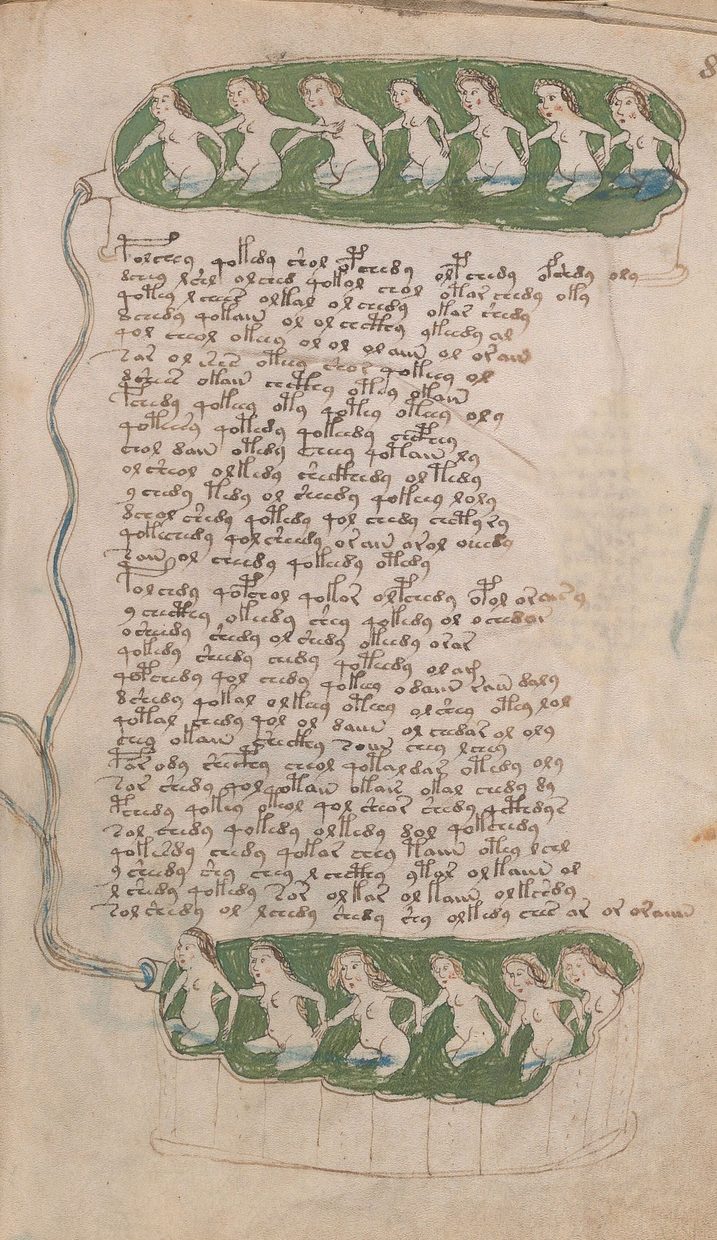
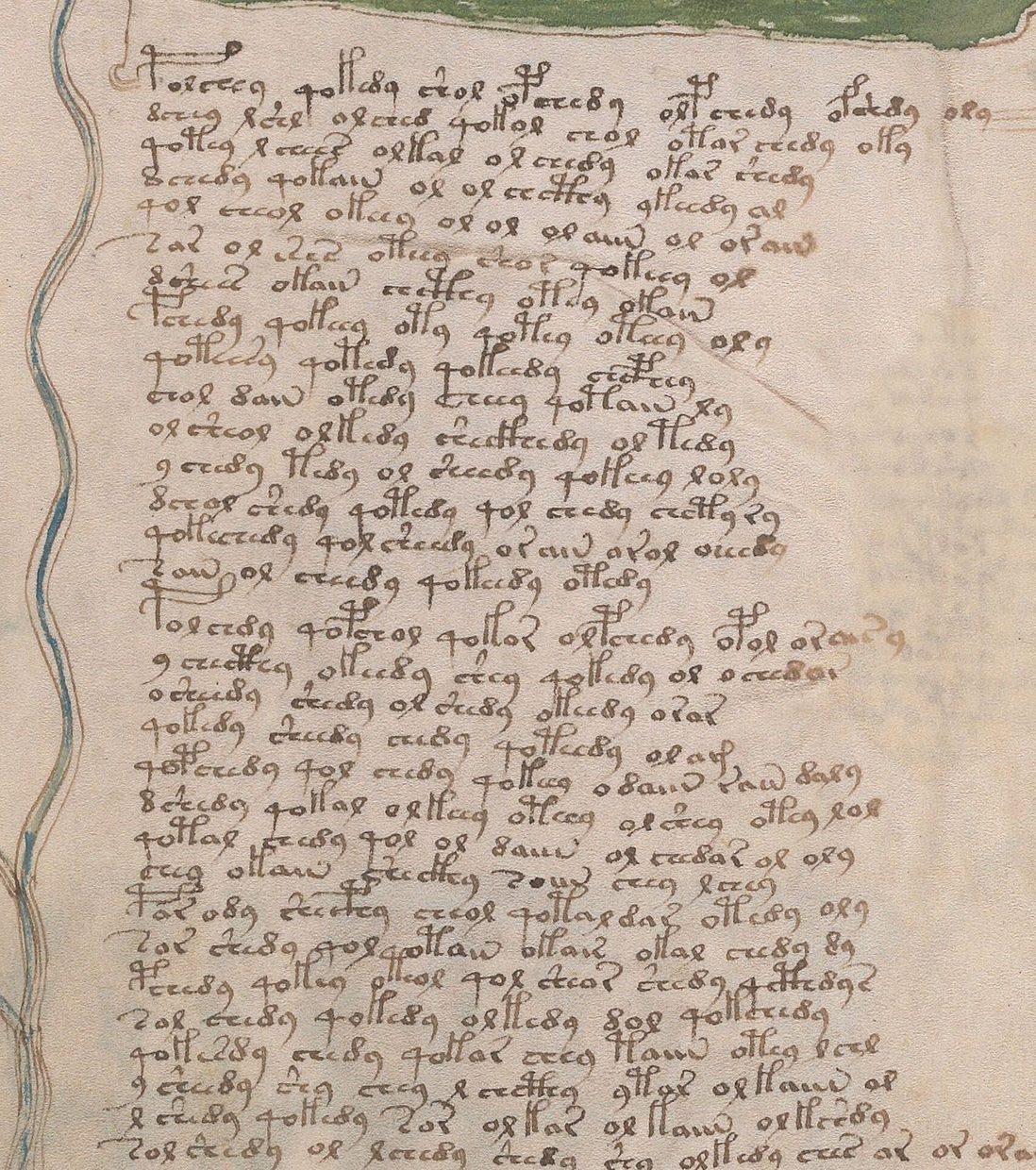
The word aiin is one of the most frequent in the manuscript: 483 occurrences. It is often preceded by s: the pair s aiin occurs 56 times. And 113 more times the book has saiin, written as one. or aiin - 51 times apart and 29 joined. ol chedy - 22 and 34. The scribe, it seems, was not entirely sure where one word ended and the next began.
The observation is an old one. We turned it into a measurable quantity, tested it on everything it could be tested on, and got one of the cleanest results of the project.
The measure
Take every pair of neighbouring distinct words in a line and ask: does the corpus contain their joined form as a single word? The share of such pairs is J. The null is the words shuffled within the line. The excess Δ = J minus the null.
The manuscript: J 8.89 % at a null of 5.16 %, excess +3.73 percentage points, z +31.6. Now the checks without which the number is worth nothing.
Five independent transliterations, five different people deciding differently where to put a space: ZL +3.73, Takahashi +2.37, Claston's v101 +4.67, FSG +1.78, Currier +1.23. All positive, all significant. Language A +3.14, language B +3.28. Pairs across a confident space (not a doubtful one) +2.62. Mid-line +3.52. In 99 % of cases the joined form stands on a different page - this is not a scribe copying the neighbouring line, it is a property of the system.
Numbers behind the chart
| Manuscript, ZL | +3.73 |
| Manuscript, Takahashi | +2.37 |
| Manuscript, Claston v101 | +4.67 |
| Manuscript, FSG | +1.78 |
| Manuscript, Currier | +1.23 |
| Canon before 07.10.2026 | +0.06 |
| 8 "word = unit" generators | +0.00 |
| Canon with the soft-space layer | +2.97 |
Who carries the effect
Pairs with a short word carry it. If at least one word of the pair is one or two signs long, J is 31 % at a null of 18 %. If both are three signs or more, the excess is only +1.04 points. The left-hand members of alternating pairs are ol, s, or, ar, o, l, r, y, qol: for o, l, s an alternating pair accounts for 65-72 % of all their occurrences. The right-hand members are aiin, l, ar, al, chedy, r, shedy, ain: for aiin, 57 %.
Short groups that go both on their own and glued to a neighbour.
Is this normal
We ran 105 texts of the period without OCR errors - Latin, Romance, Germanic - through the same measure. The manuscript sits at the 91st-94th percentile: high, but inside the range. Alternation of the same order is found in the Spanish medical texts of the fifteenth and sixteenth centuries in the HSMS transcription: de la and dela, en el and enel. Latin editions give at most +0.61 points. So the size in itself is no anomaly for the writing of the period.
The anomaly lies elsewhere. We ran the measure through the catalogue of generators. Our canon of that time: +0.06 points, a "no" on ten seeds out of ten. Eight generators in which a word is an indivisible unit (self-copying, Timm, grilles, the volvelle, templates, two-stage schemes, sign memory) - zero. The only one that carries it is a word-level Markov chain trained on the word pairs of the manuscript itself (63 %) - that is, a copy. Stream generators, in which the space is a state, give 11-38 %. A third-order chain over glyphs with the space as a symbol, trained on the manuscript, gives 61-72 %: the local statistics of the signs are enough for two thirds of the effect.
The soft space layer
Since no "word is a unit" generator gives the effect, the model needs a layer in which the word boundary is soft. We built it and accepted it by the rule: all guard windows intact, none of the fourteen axes worse, the target closed.
The design: a word assembled from a prefix and a suffix is written as two tokens, split at the seam of the cells, with a probability of 0.35 if both halves are themselves forms of the tables' lexicon; with a probability of 0.10 if only the right one is; otherwise it is not split. Gluing the first token of a word onto the previous one - 0.02. Splitting and gluing spend the line's budget: the number of words in a line does not grow. The decisions are made by a separate random number generator, so that without the layer the model matches the previous one byte for byte.
The result on fresh seeds: +2.97 points against a target of +3.73, carried by 10 seeds out of 10, the composition of the pairs as in the manuscript. Four other axes improved along the way. The defect was closed by a change of canon on 7 October 2026.
An important reservation that we recorded at the same time: a uniform split of 10 % of the words gives 97 % of the size but not the composition - in the manuscript it is free-standing words that alternate, whereas the uniform layer gives a two-humped distribution. That is why the layer is built on the word-likeness of the halves, not on a share.
The same point from the other side
Eleven days later we were testing someone else's axis: the researcher Dominik measured the link between the class of a word and the class of the next word. The canon carries the size, even overshooting it. But the composition turned out to be different: in the manuscript only 46 % of the link comes from "same class" pairs, in the canon 134 %. The missing half is transitions between different classes, and these are exactly our pairs: s aiin 54 times in the manuscript and 0 in the canon, or aiin 54 and 0.5, r aiin 22 and 0. The canon writes saiin and raiin only joined; it has 4 free-standing s against 270, and 5.5 free-standing r against 137.
Two independent axes - alternation and the class of the neighbour - ran into the same place. In the tables on which the model stands, one form in different roles encodes different letters: ol as a word is one letter, as a prefix another. The manuscript behaves as if it had a shared inventory of short groups for all positions: s, r, o, l - both a word and the start of a word. This is a hypothesis about the assembly rule, and it has to be tested with a generator, not by tweaking weights: we showed directly that strengthening or weakening the priming will not change the composition.
For understanding: everything above is about the form of the writing, not about meaning. Success would be a generator with a shared inventory that gives the alternation, the class of the neighbour and the "group plus aiin" table within a factor of two of the manuscript, without losing any of the earlier axes. Then the rule for assembling a word in the model would change - and with it, perhaps, the design of the key that the solver is looking for.
FAQ
What does joined-and-split alternation mean?
Take two neighbouring words in a line, say s and aiin, and ask whether the corpus contains the word saiin. In the manuscript such pairs make up 8.89 percent against 5.16 when the words are shuffled within the line. The excess is +3.73 percentage points, z +31.6.
Is this not an artefact of transcription - someone placing the spaces wrongly?
No. The effect holds on five independent divisions into words - ZL, Takahashi, Claston's v101, FSG, Currier - in both "languages" and across three hands. In 99 percent of cases the joined form stands on a different page - this is not local copying.
Does this happen in ordinary texts?
It does. Among 105 texts of the period the manuscript sits at the 91st-94th percentile - inside the range. Alternation of the same order is found in Spanish medical texts of the fifteenth and sixteenth centuries - de la and dela, en el and enel. What is anomalous is not the size but the fact that no generator in which a word is an indivisible unit produces it.
How is this connected to reading?
Directly - not at all. But it is one of the few cases where two independent axes pointed at the same point in the design of the cipher - short groups such as s, r, o, l go both as a word of their own and as the start of a word. If so, the rule for assembling a word in the model has to change.