What is established
Six tables and five scribes: how the text of the Voynich manuscript is built
We have not read a word, but we know how this text was made. The story of how a single anomaly - a text too predictable - grew into a model that reproduces ten statistics of the manuscript at once, and of the twenty places where it still gets things wrong.
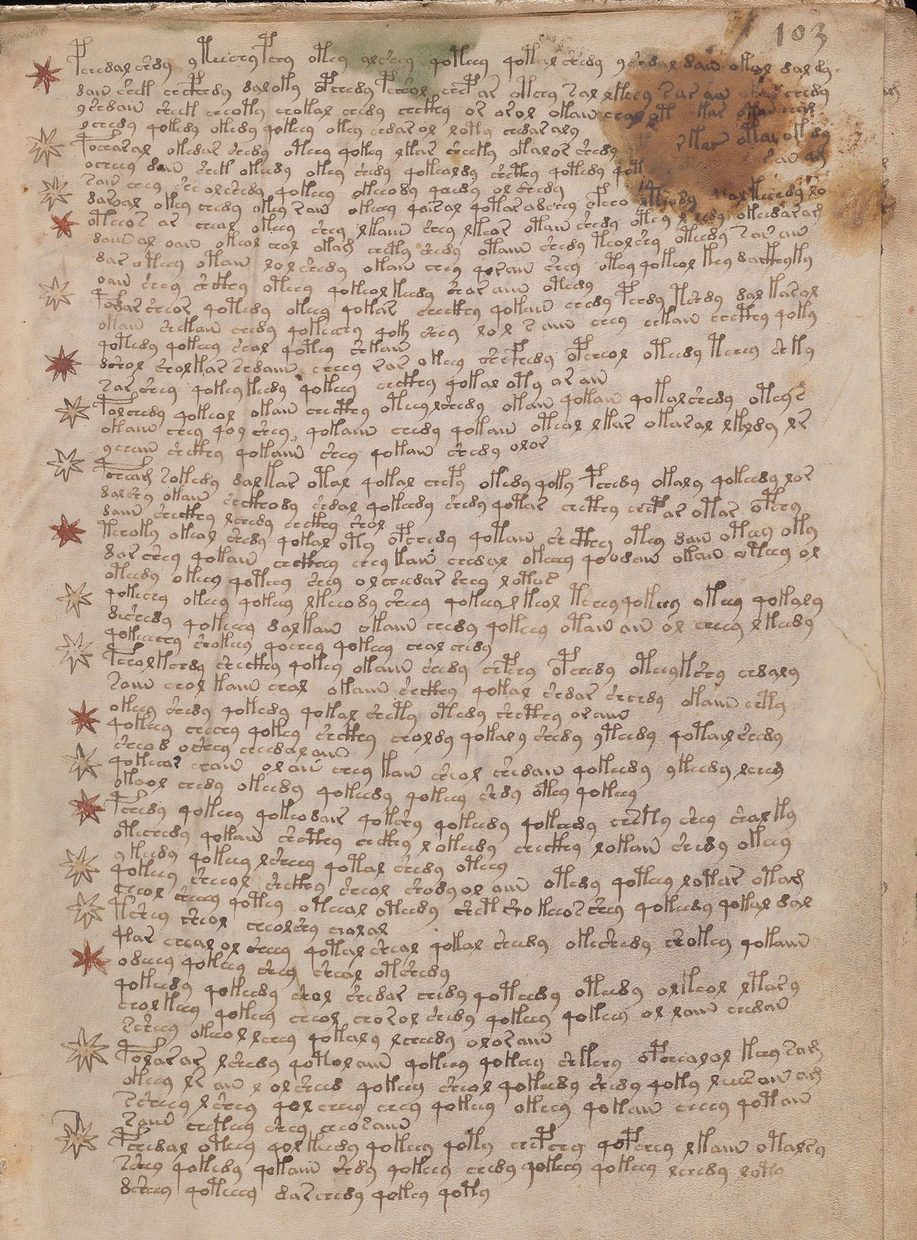
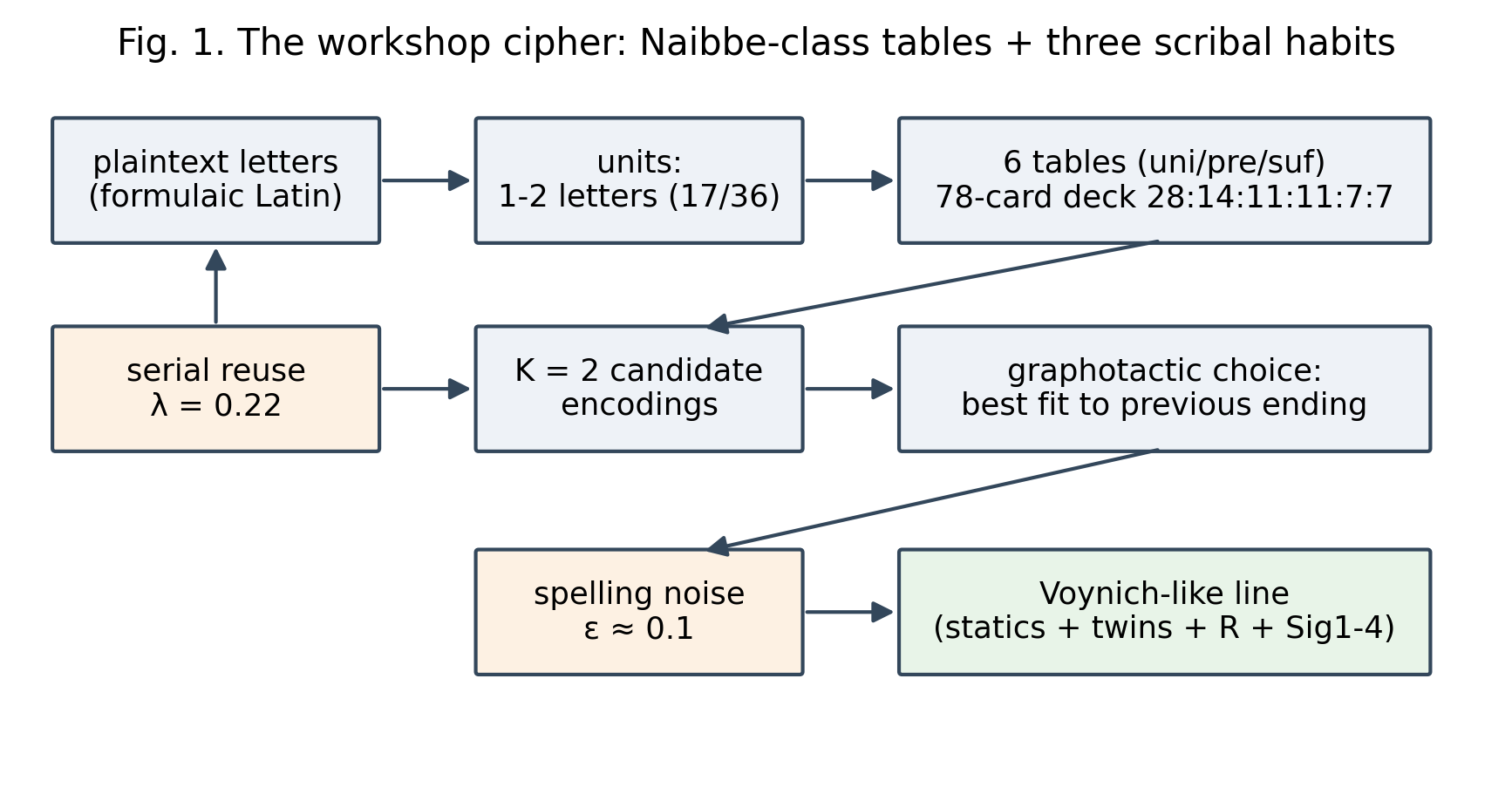
Picture a scribe with six tables in front of him. Each holds the Latin alphabet, and against every letter stands a group of foreign signs: one for the letter at the start of a word, another for the middle, a third for the end. The scribe takes a syllable of the source text, glances at one of the three tables he is working with today, and writes a "word" onto the parchment. Then the next syllable, the next "word". He is a little lazy: if a suitable group is right in front of his eyes - in the previous word of the line - he will gladly take it again. If the last word ended in a particular sign, he will pick a variant that joins onto it neatly. Sometimes he breaks one "word" into two where both halves look like words themselves.
This is not a reconstruction from a document - there is no document. It is a model that we assembled layer by layer over almost a year, and every layer was accepted only by a criterion announced in advance. Below is how it was assembled and what it can do.
The anomaly it all started from
The text of the Voynich manuscript behaves like a language - it obeys Zipf's law, it alternates "vowels" and "consonants", its vocabulary is thematic by section. And at the same time not like a language: its conditional entropy, that is, the predictability of the next sign given the previous one, is 2.08-2.30 bits. In Latin, English, Finnish, German and two dozen other languages it runs from 2.96 to 3.23. No natural language in its ordinary orthography has a value this low alongside a vocabulary this rich. We call this the empty corner, and only the manuscript sits in it.
A simple substitution cipher does not change entropy: we ran Latin through a "letter to sign" substitution, and it stayed at 3.22, exactly as before. But a "letter to two signs" substitution drops it to 2.11. That is the first argument for a verbose cipher: of all the simple mechanisms it is the only one that reproduces the text's central oddity.
The class was found independently twice
In July 2026 we ran through our metrics a text enciphered with the Naibbe system - a historically plausible cipher that Michael Greshko built out of cards and dice and published in Cryptologia. Six tables, syllabic substitution, homophones. His ciphertext of Pliny gave a low entropy of 2.08, the right word length, the right share of affixes and - above all - our sharpest feature: 80 % of the words serve about sixty "cores". The manuscript has 55 such cores, the Latin source 641.
Two independent approaches converged on one class of mechanisms. Then came our own work: a class is not yet a model.
The layers of the model and what each one closes
Each layer was added for one reason: the previous version did not reproduce some measured statistic of the manuscript. And each was accepted by one rule: all earlier measures intact, the target improved, none made worse.
Six tables. The statics: word length, entropy, vocabulary share. Fewer than six - too few doublets; a skew - spoils everything.
Doublets and reuse. The manuscript has 42 pairs of words with formally different spellings and identical contexts - ol and chey, daiin and chol. The graph of such pairs falls into exactly two components along "languages" A and B. Doublets cluster within a line 1.87 times more strongly than chance. This is seriality: the scribe reuses the units of a line with a probability of about 0.22.
Sectional dialect. The manuscript's words come in clumps: certain forms run thick over a stretch of text and are then replaced. This is reproduced if the scribe works with three of the six tables over a stretch of roughly 220 lines - the median quire. A side effect is a Taylor exponent of 0.650 against a target of 0.678, and the end of the "two languages" dispute: A and B are two lexicons of one system.
Sandhi - the word junction. Between the end of one word and the start of the next the manuscript carries 0.165 bits of information. Homophony does not give this, nor does reuse. What gives it is a choice among three spelling variants by the junction with the previous word. The junction preferences carry over from language A to language B (correlation 0.75) - a scribal custom, not a property of the plaintext.
Priming by the neighbour. The scribe more readily takes a variant with the same first sign as the previous word (weight 1.75) and of similar length (1.35). This layer closed four axes at once.
Soft space. A word of two cells is written apart with a probability of 0.35 if both halves look like words. That is how the alternation of joined and split spellings was closed.
A technology, not a handwriting
The strongest argument for a "workshop" rather than a single encipherer came from the test across five hands. The palaeographer Lisa Fagin Davis distinguishes five scribes in the manuscript. If each had encoded in his own way, the spelling variants of the different hands would diverge. They converge: the divergence between hands is 0.050 against 0.163 in controls, p below 0.001. All five scribes use the variants in the same proportions. The tables were shared. More in the article Five scribes, one key.
What the model reproduces
Ten statistics at once: entropy 2.17, vocabulary share 0.30, share of doublets 1.2 %, their clustering 1.87, information gain at the junction 0.165, the rise of y → q by 1.77 times, vocabulary concentration, share of repeats 0.94 %, clustering 1.75, and all four of Parisel's "signatures" - the boundary statistics that the French researcher proposed as a criterion of real text. Four out of four, without tuning.
And a control from the other side: sixteen rival generators - Timm's self-copying, grilles, volvelles, Markov chains, two-stage schemes, Lanzini's asemic generator, recent architectures with memory - and not one of them passes our profile. Almost all of them tear at the same place: the clustering of doublets.
Where the model gets it wrong
An honest list matters more than a triumphant one. The model has twenty open defects - measured statistics of the manuscript that it does not carry. The main family is the vocabulary: the manuscript keeps producing new forms where the model's vocabulary is exhausted. The limit is located precisely: the assembly rule "a word is one cell, or a prefix plus a suffix" covers 77.7 % of word tokens but only 36.4 % of distinct forms. A repair within the class closes half the gap; beyond that the rule itself has to change.
Two defects are especially interesting, because none of the sixteen mechanisms carries them either - line openers and the positional choice of form within a line. That is no longer our mistake but a constraint on any class of explanations. The full table with numbers is on the page Model defects.
Why this is not a decipherment
The model says HOW the text was made, not WHAT is written in it. We checked whether a key can be derived from the model: a solver constrained to six tables cracks synthetic text of the same design with an accuracy of 0.95, and on the manuscript gives a gain of 0.04-0.07 against a threshold of 0.5 - under Latin, Armenian, Coptic, Old French, Catalan, Italian, Occitan, Spanish and Middle High German. So the manuscript is not "our canon exactly, plus a known language". Either the language is different, or the key is built differently in details to which the solver is sensitive - and it is sensitive even to a single scribal error in a table. What this means for the chances of reading is in the article Anchor threshold.
For understanding: everything said here is a model of the mechanism, tested on statistics, not a reading. Success would be the discovery of the tables themselves or of the source text; then the model becomes a reading tool within hours.
FAQ
What is a verbose cipher?
A cipher in which one unit of the source text - a letter or a syllable - is replaced by several signs. The text gets longer as a result, and the predictability of the next sign rises - exactly what we see in the manuscript.
How do you know there are exactly six tables?
By search. With fewer than six, the model does not give the required number of word doublets; a skew in table usage spoils all the other measures. Six balanced tables are the only point where ten statistics converge at once. Michael Greshko arrived at the same class independently in the journal Cryptologia in 2025.
So the text can be deciphered by fitting the tables?
No. We tested this directly - a solver that cracks synthetic text of the same design with an accuracy of 0.95 stays silent on the manuscript under ten languages. Either the source language is not among those tested, or the design of the key differs from our model in details to which the solver is sensitive.
What else is wrong with the model?
It has twenty measured defects - statistics of the manuscript that it does not reproduce. The main family is the vocabulary: the manuscript keeps producing new forms where the model's vocabulary is exhausted. The full list with numbers is on the "Model defects" page.