Images and pages
The list pages: where the manuscript stops being text and becomes a reference table
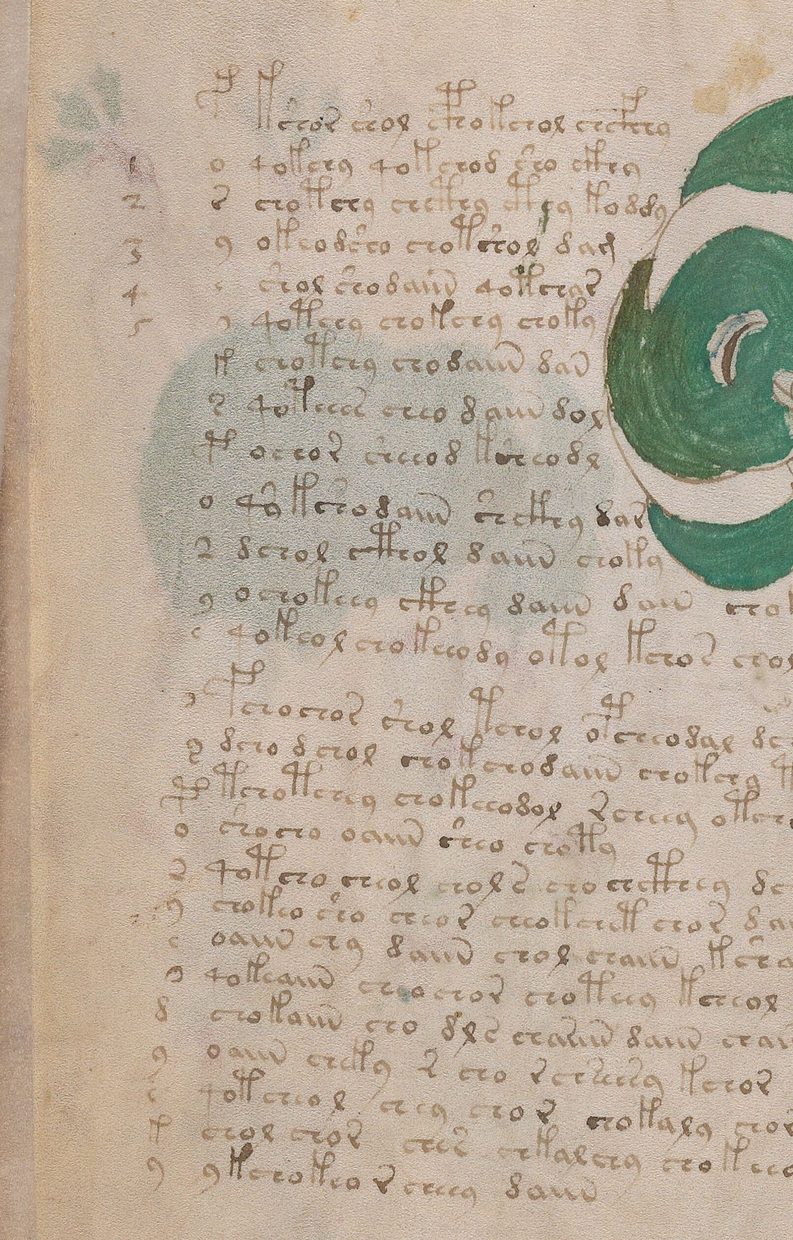
Three leaves of the manuscript are not built as text. On f57v single signs run around a ring, repeated four times. On f49v a column in the margin is periodic. On f66r there is a list of short words. These pages use a different set of signs, give the largest residual of the model and are joined by codes found nowhere else. What they are, we do not know. That they are not text has been shown.
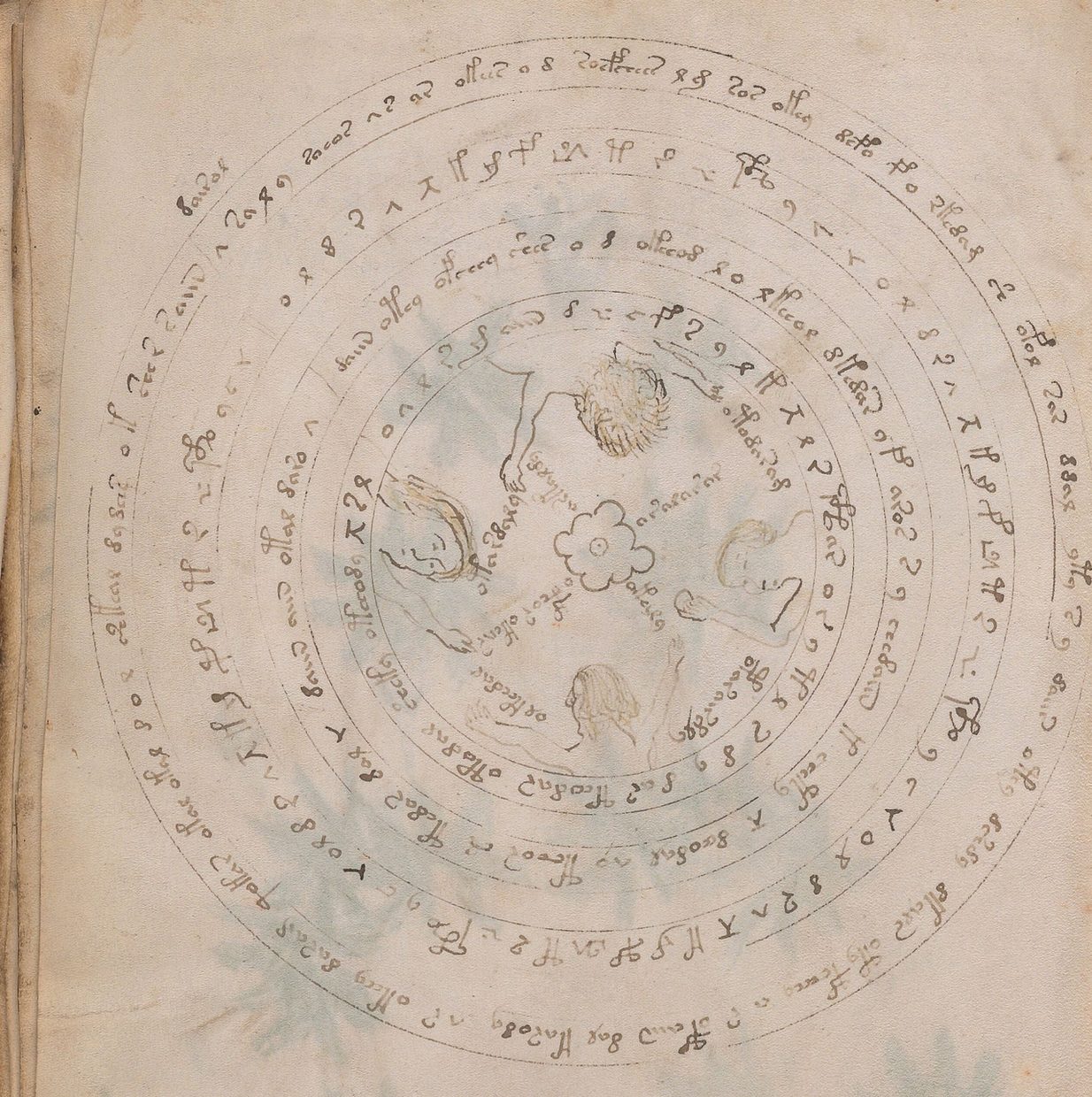
Most of the manuscript is text: paragraphs, lines, words. But there are three leaves where the words run out. On f57v single signs run around one of the rings. On f49v a column is written out alongside the text. On f66r there is a list of short words, each on its own line. For a century these pages have drawn hunters after the alphabet and the key. We asked something simpler: do they differ from the text measurably, and in what.
A ring of eighteen
The ring f57v.3 is one sequence of 18 units repeated four times. The four passes diverge in exactly two slots: in the ninth stand f, f, p, p, in the seventeenth I, c, c, c. We unrolled the ring into a strip mechanically - the centre fitted by geometry, a radius of 800-930 pixels - and satisfied ourselves by eye that the signs really are separate single signs, not words.
The first test: does the ring use a different set of signs? There is a circular trap here: if the frequencies are counted over the whole corpus, the ring itself raises the frequency of its own signs. We counted without the list pages. The result: f57v has 9 rare signs out of 18, f49v 4 out of 12, both p less than 0.0001, jointly less than 0.00001. The third candidate, f76r, did not pass - 0 out of 7, p 1.0. The class is not homogeneous: two pages out of three carry the effect.
The second test is the most beautiful. The pair f and p, on which the repeats diverge in the ninth slot, is in the rest of the text the most interchangeable pair of the corpus: a cosine similarity of contexts of 0.948 against 0.817 for the next pair. The list marks a variant exactly where the system allows one. The pair I and c cannot be tested - I occurs once in the corpus.
The column of f49v
On f49v a column of single signs runs alongside the text. It is periodic: shift 7, p 0.0003. Seven is a number that in the fifteenth century means the days of the week more often than anything else, but that is an interpretation, not a result; the result is the periodicity.
The bridge
Three independent lines converged on the pair of leaves f57v and f66r.
The first is the transliteration codes. In the transliteration file unusual signs are marked with codes; two codes, @169 and @172, occur only on these two leaves. Nowhere else in the book.
The second is the rare glyphs. The glyph x occurs 41 times in the manuscript, and 21 of them are on the three list pages - f57v, f66r and the rosettes - which make up 2.8 % of the tokens. 51 % against 2.8 %. We put an internal control in place at once: not all rare glyphs cluster - x 51 %, v 93 %, but g 4 %, b 0 %. The version "unusual pages collect everything strange" does not pass. There remained the version of "the transcriber's basket" - that x and v simply mark shapes the transcriber could not classify. An independent transliteration removed it: in the positions where the main file puts x, Claston in his v101 alphabet puts a sign rare for him in 93.8 % of cases against 19.5 % in a control from the same pages, p 0.005. Two people independently saw an unusual sign there.
The third is the residual of the model. We trained a trigram model of signs on our generator alone, without the manuscript, and measured how much worse it predicts each page of the manuscript. The residual is localised: the spread across pages is 4.95 times larger than for the generator, p 0.005. After subtracting word length, volume, section and language, f57v remains an outlier - first place out of 226 pages, +1.919 bits; f66r is in the top ten.
Three lines - codes, rare glyphs, residual - on one pair of pages. This is a lead, not a conclusion: we have not yet set a separate preregistered test of "what f57v and f66r have in common".
A genre parallel
In September, going through the Hartlieb collection of 1456 in search of secret alphabets, we came upon onomantic circles - divinatory rings by the letters of a name, common in German manuscripts of the fifteenth century. They are built the same way: a ring divided into cells of one sign or number each, with the days of the week labelled around the rim. Formally this is the same type as f57v.3.
So the wording has to be kept exact. A ring of single-glyph cells is not in itself an anomaly - it is a genre. The content is anomalous: by distinctness and repetition the ring of f57v stands first among the 61 rings of the manuscript. It can be checked further at low cost - how many such circles there are in the German onomantic texts and what the series length is there: if 7, 12 or 28 (calendrical), then the Voynich 18 stands apart.
What this means
The list pages are a different mode of writing. Not a hidden meaning but a purpose: a reference table, an inventory, a working record of the workshop. For the hunt for the key this matters - the workshop kept working records; the habit is shown, not assumed. For reading - nothing so far: the meaning of the ring's signs is unknown, and we cannot claim "this is the alphabet".
For understanding: everything above is about the purpose of the pages, not the meaning of the signs. Success would be an external list of sigla or an alphabet with which the ring of f57v matched by inventory and order; the hapax ddsschx from the rosettes - the only word in the book with a doubled ss, confirmed by three transliterations - awaits the same.
FAQ
What is special about the ring on f57v?
It is the only place in the manuscript where single signs, not words, run around a ring - a sequence of 18 units repeated four times, with a divergence in exactly two positions. Nine of the eighteen signs are rare in the rest of the text. Many see an alphabet or a key in it.
Is it the alphabet of the manuscript?
That cannot be tested directly. What has been shown is that the ring and the column of f49v use signs that are almost absent from the text, and use them not at random - the pair of signs that replace each other in the ring in the two divergent repeats is the most interchangeable pair of the corpus in the text. The list marks a variant where the system allows one.
What is the bridge between f57v and f66r?
The transliteration has codes for unusual signs. Two codes occur only on these two leaves and nowhere else. In addition, both leaves are among the few where the rare glyph x concentrates. In addition, both give the largest residual of the model - the text there is predicted worst of all. Three lines converge on one pair of pages.
How unusual is this for fifteenth-century manuscripts?
A ring of single-glyph cells is in itself a norm of the genre - German onomantic circles of the same century are built the same way. What is unusual is the content - by distinctness and repetition the ring of f57v stands first among the 61 rings of the manuscript.