Map of findings
Map of findings: everything we have learned about the Voynich manuscript, on one page
Three years of tests, 256 numbered checks, two dozen near misses and not a single word read. This page is the table of contents to all of it - what is proven, what holds only locally, where one step was missing, and what is closed for good.
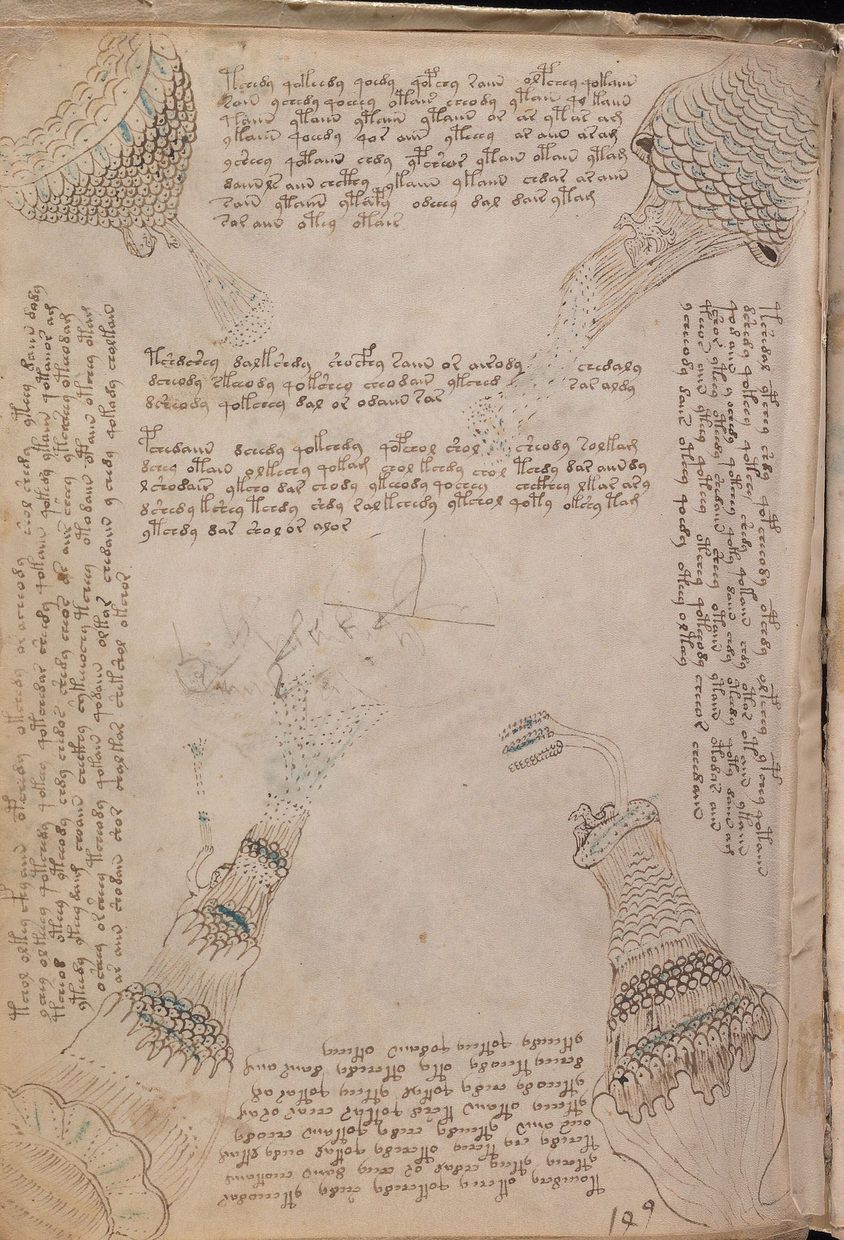
If you opened all our reports one after another, you would get more than a megabyte and a half of text: a journal of five hundred entries, two papers, registers of leads and near misses, twenty open defects of the model. This page is a way not to drown. It is a map: what we consider established, what holds only locally, where we were one step from a result, and what is closed so firmly that it is not worth reopening.
First, a word about the rules, because without them the map cannot be read. We publish no readings. Not one. Any match between the manuscript and a language, a calendar or a book is a hypothesis that must pass three trials: a success threshold set in advance, a control against chance, and a control against "any other" candidate of the same dose. Everything below passed or failed in exactly that way.
What is established
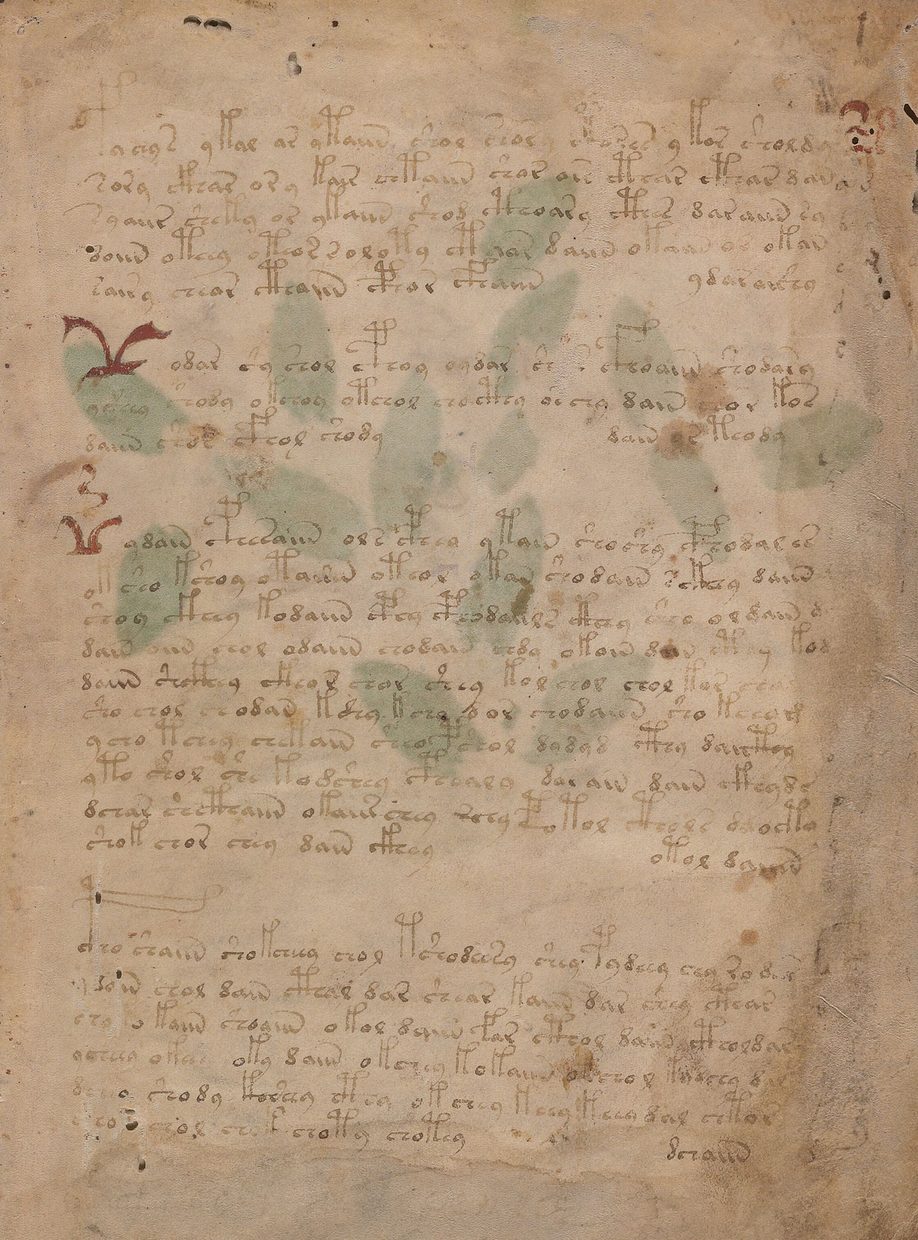
The text was made by a meaningful technology. It obeys Zipf's law, it alternates "vowels" and "consonants" the way Latin does, and its vocabulary is thematic by section. At the same time its conditional entropy - a measure of how predictable the next sign is - is lower than in any of the 27 natural languages we tested: 2.08-2.30 bits against 2.96-3.23. That is the manuscript's central oddity, and it is also the key. More on the empty corner.
The mechanism of the text has been recovered. One syllable of the source language is replaced by a whole "word" from one of six substitution tables. The tables are shared by all five scribes: the spelling variants of the different hands agree more strongly than in controls (divergence 0.050 against 0.163). A scribe works with three of the six tables over a stretch of about 220 lines - hence the famous "languages A and B" and the clustering of words. The model reproduces ten statistics of the manuscript at once; sixteen rival generators hold none of them. How we built it.
The labels on the zodiac rings are abbreviations of names. About thirty unique labels per sign, a grammar of their own with six markers, numbers rejected four times. The stem of a label is shared across a leaf (p 0.0004) - the labels are built like a nomenclator. Thirty names per sign.
Lines remember each other. The opening of a line avoids the opening of the previous one (6.9 % repeats against 13.5 % expected, z +24), and there is a directed cycle of openers d → q → y that vanishes if the lines are re-flowed. None of the sixteen mechanisms produces this - a constraint on a whole class of explanations. Line openers.
The manuscript's space is soft. Two neighbouring words also occur in the corpus run together: 8.9 % of pairs against 5.2 % at random. This is a property of five transliterations at once, and we reproduced it with a separate layer of the generator. Soft space.
The book was written by bifolios. Conjugate leaves of one double sheet resemble each other beyond mere adjacency (z −5.2 on 23 pairs) and share vocabulary. Five scribes, one key.
The key cannot be recovered by computation - and we know why. A full key would read 96.9 % of the text, but to recover it one needs an aligned sample of 530-660 Latin words. Every known candidate is two to three orders of magnitude smaller. Anchor threshold.
What holds locally
The shift of 23 on the zodiac. A feature of the nymph - her headgear - matches al-Biruni's table of masculine and feminine degrees at a shift of 23 positions; a blind test gave p 0.0088 with the peak exactly at 23. But that is Pisces, Aries and Taurus. On the six signs from Cancer to Sagittarius - zero. A zodiac by degrees.
Links between words. sh- predicts a "gallows" root in the next word (z +12.5), qo- behaves like a code slot. The facts are robust but have no discriminating power: a simple character-level chain that knows neither words nor lines reproduces them.
The twelve moons of f67r2. The colour sequence Y R Y Y R R Y R Y R Y R is a fact, Stolfi's table is refuted, but there is no external referent. Twelve moons.
The month names. No one of the 25 scripts of the Gallo-Romance corpus reproduces the set of forms; the "north or south" dispute cannot be settled on the available material. Month names.
Where we came close
This is the most interesting part of the map. The full list is in the article Near misses; here are the five main ones.
| what almost worked | how close | what killed it |
|---|---|---|
| The Lleida calendar of 1524 as a key to the labels | passed Bonferroni (p 0.0020), replication (p 0.0040) and a held-out sample | the signal was carried by saints canonised after 1438 |
| Ketham's book of 1494 as the source of section Q20 | margin of 0.14 % to the null threshold | the block order was not confirmed (Δ +0.015 at a null of +0.033) |
| The lapidary of Alfonso X | p 0.008 at a threshold of 0.005, peak exactly at 23 | alignment drift in the parser; after the fix p 0.077 |
| The shift of 23 | blind replication, specificity ×3 | does not generalise beyond three signs |
| The Milan cipher of 1424 as a specimen of the class | syllabic writing inside the radiocarbon window | entropy 3.86 against 2.2 in the manuscript |
Three lessons from this section. First: three formal barriers in a row are no guarantee if the structure of the match has not been checked (Lleida). Second: a margin of a fraction of a percent demands a confirmatory procedure with a new null, otherwise it is an artefact (Ketham). Third: a signal replicated blind can be real and still useless for reading (the shift of 23).
What is closed by the numbers
Briefly, so that nobody reopens it. Languages by structure: Sanskrit, Etruscan, the Aztec version, East Asian languages, the Armenian trail (four channels - four zeros), Hebrew anagrams, Cheshire's proto-Romance. Ciphers: simple substitution, the Cardan grille (twice), "glyphs as abbreviation marks", word substitution in four ways, the Caspari-Faccini and Molina keys. Cribs by degree: eighteen classes of lists, including the cisiojanus, the Astrolabium of 1488 and calendars of saints. The plant crib: a plant name survives neither in a word nor in a line. Order of entries: 182 texts against six sections of the manuscript - zero everywhere. Analyses of other people's versions are in the section Hypotheses and how we tested them.
Five doors
Where else one can go when no language and no list has fitted.
1. The door of the key. A physical document - the workshop's tables, 414 lines of correspondences on one or two leaves. The trail runs through Kircher's legacy. Hunt for the key. 2. The door of the passage. One identified text of half a thousand words in its proper place would read 60 % of the manuscript. The tool is ready; what is missing is the corpus. Door number two. 3. The door of the labels. An external list of names, thirty per sign. Eighteen classes are closed, but not all of them. 4. The door of the mechanism. A change of model class where ours runs into the wall: the rule for assembling a word and the shared inventory of short groups. It will not give a reading, but with the right model the solver will work again. 5. The door of the images. An external feature in a drawing - costume, instrument, calendar arc. Statistics of form do not distinguish intention; a document of the period is needed.
No door is open yet. This page is updated at every shift of the map; the date at the top is the date of the last check.
FAQ
What, in the end, has been established about the Voynich manuscript?
The text is neither gibberish nor a simple cipher but the product of a workshop technology - a verbose cipher with six substitution tables shared by all five scribes. The labels on the zodiac rings are abbreviations of names from closed lists, thirty to a sign. The content, meanwhile, cannot be read, and we have shown why - the external anchor is too small.
Were there moments when a decipherment seemed close?
Yes, at least twenty. The Lleida calendar passed three statistical barriers before falling apart on an anachronism. A Spanish medical book of 1494 matched the order of the manuscript's paragraphs with a margin of 0.14 percent - and failed confirmation. All such cases are gathered in a separate article on near misses.
Why do you not name a single word you have read?
Because no reading has passed control. The project rule is simple - a coincidence is not a reading until it has survived a test against chance and against other languages. Any reading without such a test is an invention, and we do not publish those.
Where are the details and the data?
Every line of this map leads to an article in this section or to a test number. The scripts, data and reports are in the replication package on the "Data and code" page.