Near misses
Twelve moons: what colour says on leaf f67r2 and why the computus did not fit
On the astronomical leaf f67r2 twelve faces of the moon stand in a circle, some of them yellow, some red. We unrolled the ring, fixed the sequence and refuted an old table. Then we tested the only serious candidate for an explanation - the medieval reckoning of lunar months. Ten matches out of twelve. Not enough.
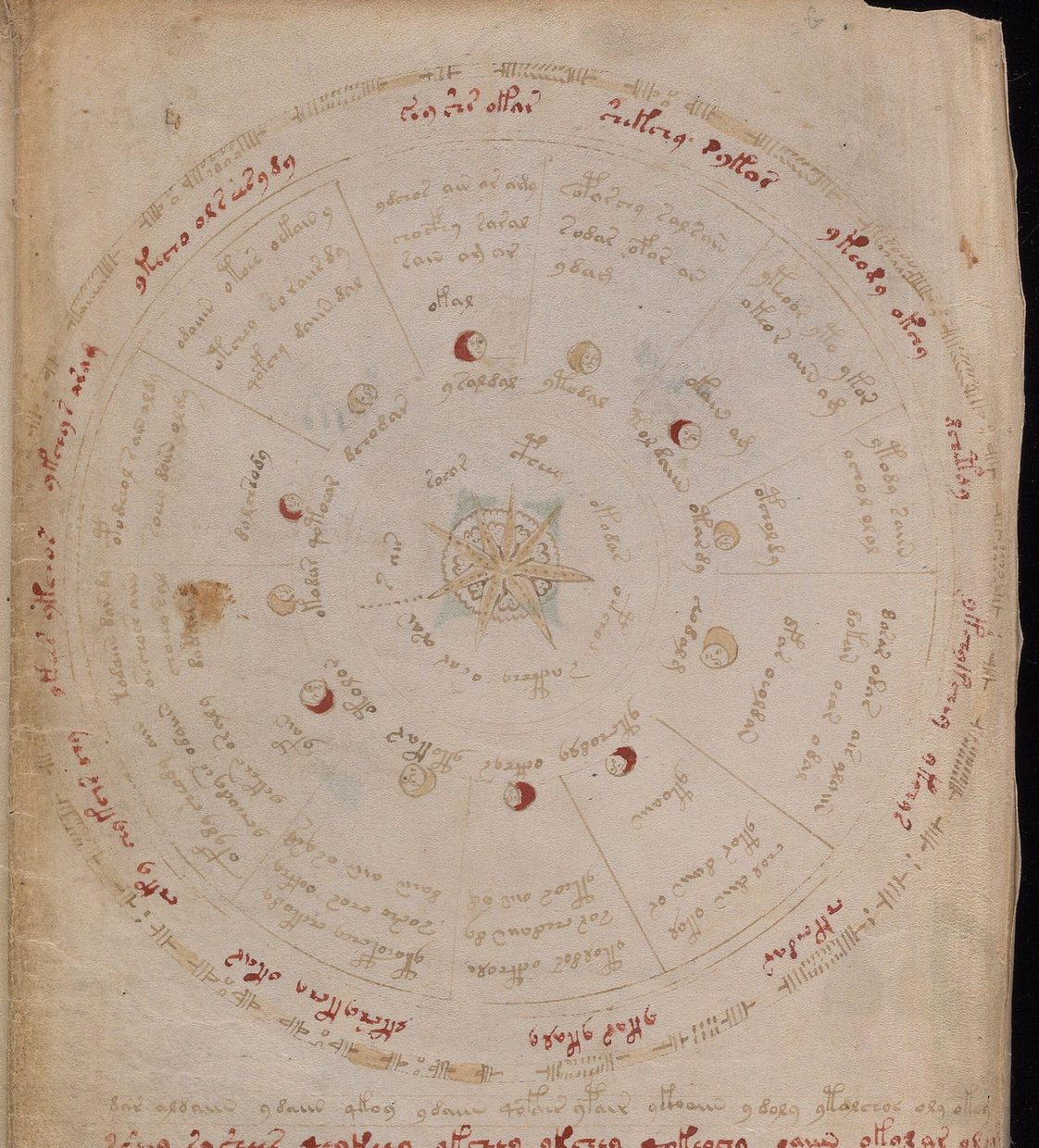
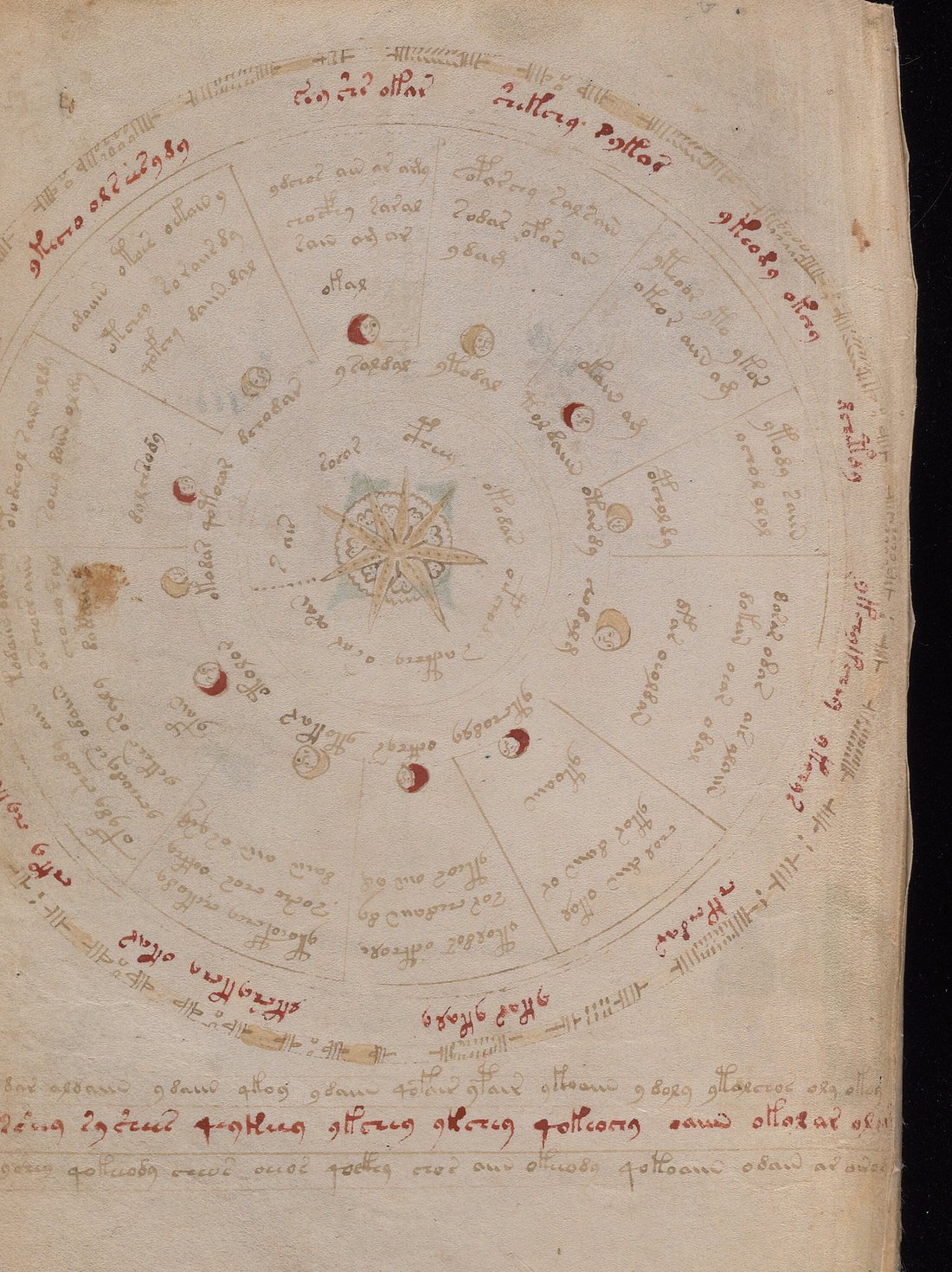
Among the astronomical leaves of the manuscript there is one where the image itself speaks in binary. On f67r2 twelve faces of the moon stand in a circle, and they are of two colours - yellow and red. Twelve positions, two states. If a simple testable structure is built into the book anywhere, it is here.
First - what is actually there
The first task was not to interpret but to fix. Colours on medieval parchment are a treacherous thing: red fades, yellow goes brown, and two researchers can see two different sequences. We unrolled the ring into a strip mechanically, by angle, and obtained a sequence that can be checked against the scans: Y R Y Y R R Y R Y R Y R. Twelve positions, six and six. Two pairs of identical neighbours - YY at about three to four o'clock and RR at about five to six.
This at once refuted a table that had circulated in the literature since 2000: Jorge Stolfi described strict alternation in the zone from half past three to half past six. There is no alternation there - there are pairs. The fact is objectified, the table withdrawn.
The only serious candidate
What in the fifteenth century was divided into twelve and painted in two colours? The lunar months of the computus. In the medieval church reckoning the lunations are full - 30 days - and hollow - 29; they alternate, the January one is full, and the intercalary lunation of a leap lunar year is absorbed by a calendar month. Twelve months, two states. A perfect candidate.
We did everything by the rules: preregistration, a referent from a cited source - Bede's "The Reckoning of Time" in Wallis's translation, the glossary and the introduction, with page numbers - and only then the script.
The first discovery was about the referent itself. Bede's rules - "a lunation belongs to the month in which it ends", "full and hollow alternate, the January one is full", "the embolism is absorbed" - give the same string for all nineteen golden numbers of the lunar cycle: F H F H F H F H F H F H. The freedom to "pick a year" turned out to be an illusion. The referent is degenerate.
Against this string the manuscript gives at most ten matches out of twelve at the best rotation. That sounds like a lot. But random necklaces of six yellow and six red reach ten out of twelve in 8.6 % of cases. p 0.0855 at a threshold of 0.01. The negative control - Stolfi's strings - 6 out of 12, p 1.0. Not passed.
Why this is a miss and not a zero
Structurally the difference between the manuscript and the computus comes down to one thing: over twelve positions the computus has no pairs of identical neighbours, and the manuscript has two. Pairs appear in the computus only in a reckoning of thirteen lunations - in years with an embolism. But thirteen is not twelve, and folding thirteen into twelve so that the pairs fall into place would be fitting. We did not do it.
So the referent is not "the wrong one" but "almost the right one": the right idea - a binary marking of the lunar year - but not the right realisation. What is needed is a fifteenth-century source with a binary marking of exactly twelve positions, in which the positions come in pairs. Bede's computus has none. In the weather lore by the colour of the moon - golden for clear weather, red for wind, from Virgil through Pliny to Bede - the opposition of colours is there, but nobody counted twelve positions; this is a note without a test.
A neighbouring lead that died of its date
Another version for the same leaf circulated on the forums: the seven words in the sectors of f67r2 are "planetary labels", repeating seven labels on another zodiac leaf. The pattern of word distribution 4-1-1-1 on the leaf is real. But the correspondence of seven words to seven labels is exactly chance: a match score of 2, p 0.706 and 0.210 in two settings. And the scheme itself, against which the comparison was made, is in print no earlier than 1494 - against the radiocarbon 1404-1438.
What remains
The sequence Y R Y Y R R Y R Y R Y R remains a fact. It has no referent. This is one of the few cases in the project where we know exactly what we are looking for - a source with twelve binary positions and pairs - and have not found it. The lead is open.
For understanding: the colour of the moons is image, not text; a match with a source would give not a reading but a tie between the leaf and a tradition. Success would be a fifteenth-century manuscript in which twelve moons are painted the same way - then one could ask what is written in its sectors.
FAQ
What is shown on f67r2?
A circular diagram with twelve faces of the moon around the rim and text in the sectors. The faces are of two colours - yellow and red. It is one of the few leaves where the image itself carries a binary code.
What is the computus?
The medieval system for calculating the church calendar, above all Easter, by reconciling the solar year with the lunar months. In it the lunations are full and hollow, 30 and 29 days, and alternate by rule - a natural candidate for twelve two-coloured moons.
Why are ten matches out of twelve too few?
Because random sequences of six and six score as many in 8.6 percent of cases. The discovery threshold stood at one percent; the result was 8.55. Moreover, the referent itself turned out to be degenerate - Bede's rule gives the same string for all nineteen years of the lunar cycle, so the "freedom to choose a year" was an illusion.
What is missing?
A fifteenth-century source with a binary marking of exactly twelve positions - in which the positions come in pairs, as in the manuscript. The computus has no pairs over twelve positions; they appear only in a reckoning of thirteen lunations, and thirteen is not twelve.