Near misses
The Armenian trail: how we closed the language four ways - and what we found on the road
The theory that the manuscript's language is Armenian rests on two things, similar-looking letters and plants from the East. We tested the structure of the text, the shape of the signs by fonts and by real manuscripts, ran a blind quiz - and got four zeros. Then the manuscript's doubled syllables led to a fifteenth-century book of remedies and three independent traditions. That turned out to be a miss of a different kind.
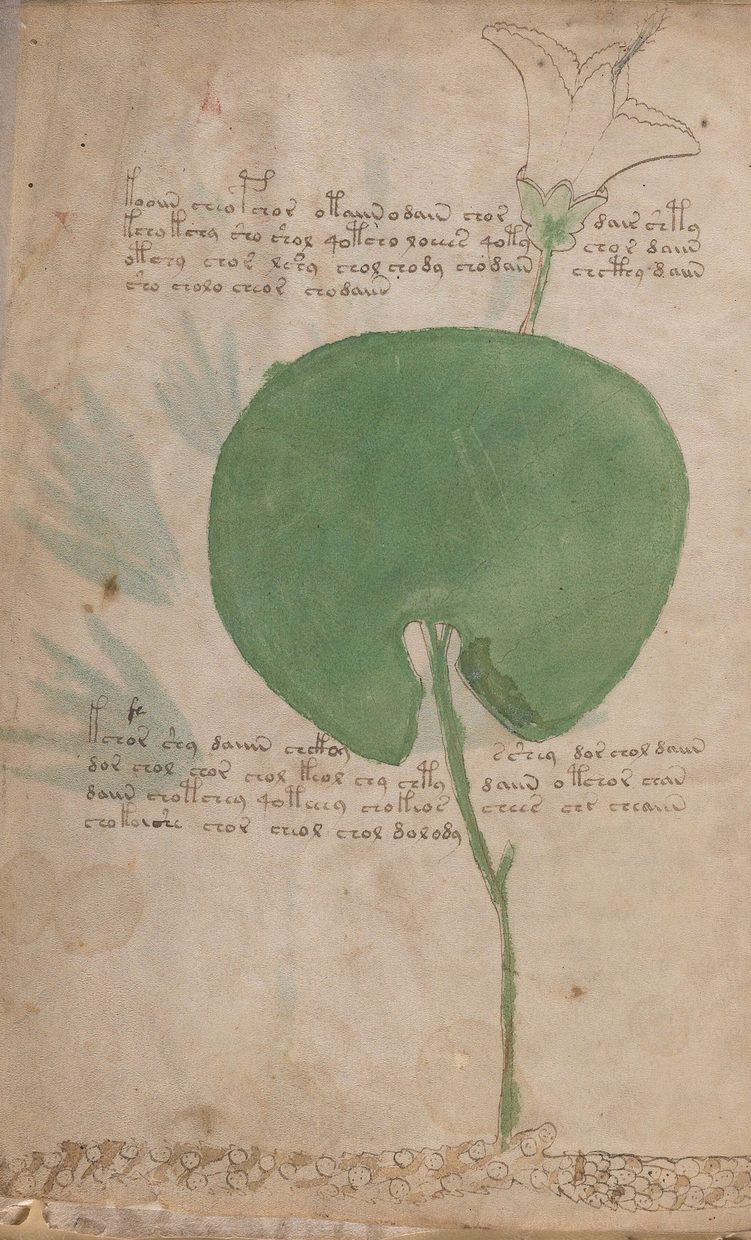
The Armenian version of the Voynich manuscript is one of those that live for decades on two arguments: some signs look like Armenian letters, and among the plants of the herbal there are eastern ones. The arguments are weak, but the project's rule is to develop a version first and judge it afterwards. In August 2026 we developed it along four independent channels. All four gave zero. And on the road we found something we were not looking for.
Channel one: the structure of the text
If the manuscript is an Armenian text under our cipher, its statistical fingerprint should be closer to the manuscript than that of Latin. We took two corpora: fifth-century Grabar (393 thousand letters) and the fifteenth-century book of remedies of Amirdovlat Amasiatsi (959 thousand) - the latter doubly important, because a book of remedies is the model of the genre we take to be the genre of the manuscript.
A battery of six axes at equal volume: Armenian passes one, Latin three. Clustering of doublets 1.44-1.51, doublets 2.5-2.9 %. A control for the projection of the alphabet (38 letters against 22) does not explain the gap, though the gap is small. The word kchor, which supporters read as the name of a plant, occurs 19 times on 19 different plants - the label of a single plant does not behave like that. We would not reject a language on a single fingerprint - this is the first zero of four, not a verdict.
Channel two: the shape of the letters by fonts
How similar are the signs of the manuscript to Armenian letters? We compared them by fonts - Armenian, Latin, Greek, Cyrillic, Georgian - with the criterion set before the run. Armenian is indeed closer than Latin, Greek and Cyrillic (p 0.000). But Georgian Mkhedruli is exactly as close: 0.749 against 0.754, p 0.901. This is a property of the class of rounded cursives, not of Armenian. Nine of the ten best pairs match only through rotation or mirroring.
Channel three: the shape of the letters by real manuscripts
Fonts are an idealisation. We cut 300 fragments from real manuscripts of the period: Armenian bolorgir from two codices of 1455 and 1475 - exactly the radiocarbon window - and fifteenth-century controls: Latin bastarda, Greek minuscule, Georgian Mkhedruli. From the manuscript - two leaves, one for each "language". The cutting mechanical, the criterion before the data, the contrast normalised so that the style of photography would not betray the source.
The signal inverted. Armenian came out worst of all: 0.788 against 0.792 for Latin, 0.796 for Georgian and 0.810 for Greek. The similarity by fonts was a property of the fonts, not of the letters.
Channel four: a blind quiz
The last check was the human eye without knowledge of the hypothesis. Thirty tasks, each with eight options, two per script, anonymised fragments, the option of choosing up to three or answering "none". The scoring frozen before the answers. Choice under the null - 25 % per script. The result: Armenian 28.1 %, Latin 28.9 %, Greek 21.9 %, Georgian 21.1 %, p 0.342. "None" - in 11 tasks out of 30. A slight leader - Latin, in unison with another test in which the shape of the manuscript's signs matched the Latin palaeography of abbreviations.
Four channels, four zeros. The Armenian language is closed.
Numbers behind the chart
| Channel 2: similarity of signs to fonts - Armenian | 0.749 |
| Channel 2: similarity of signs to fonts - Georgian | 0.754 |
| Channel 3: similarity to real 15th-century manuscripts - Armenian | 0.788 |
| Channel 3: similarity to real 15th-century manuscripts - Latin | 0.792 |
| Channel 3: similarity to real 15th-century manuscripts - Georgian | 0.796 |
| Channel 3: similarity to real 15th-century manuscripts - Greek | 0.810 |
| Channel 4: blind quiz, human choice, % - Georgian | 21.1 |
| Channel 4: blind quiz, human choice, % - Greek | 21.9 |
| Channel 4: blind quiz, human choice, % - Armenian | 28.1 |
| Channel 4: blind quiz, human choice, % - Latin | 28.9 |
What was found on the road
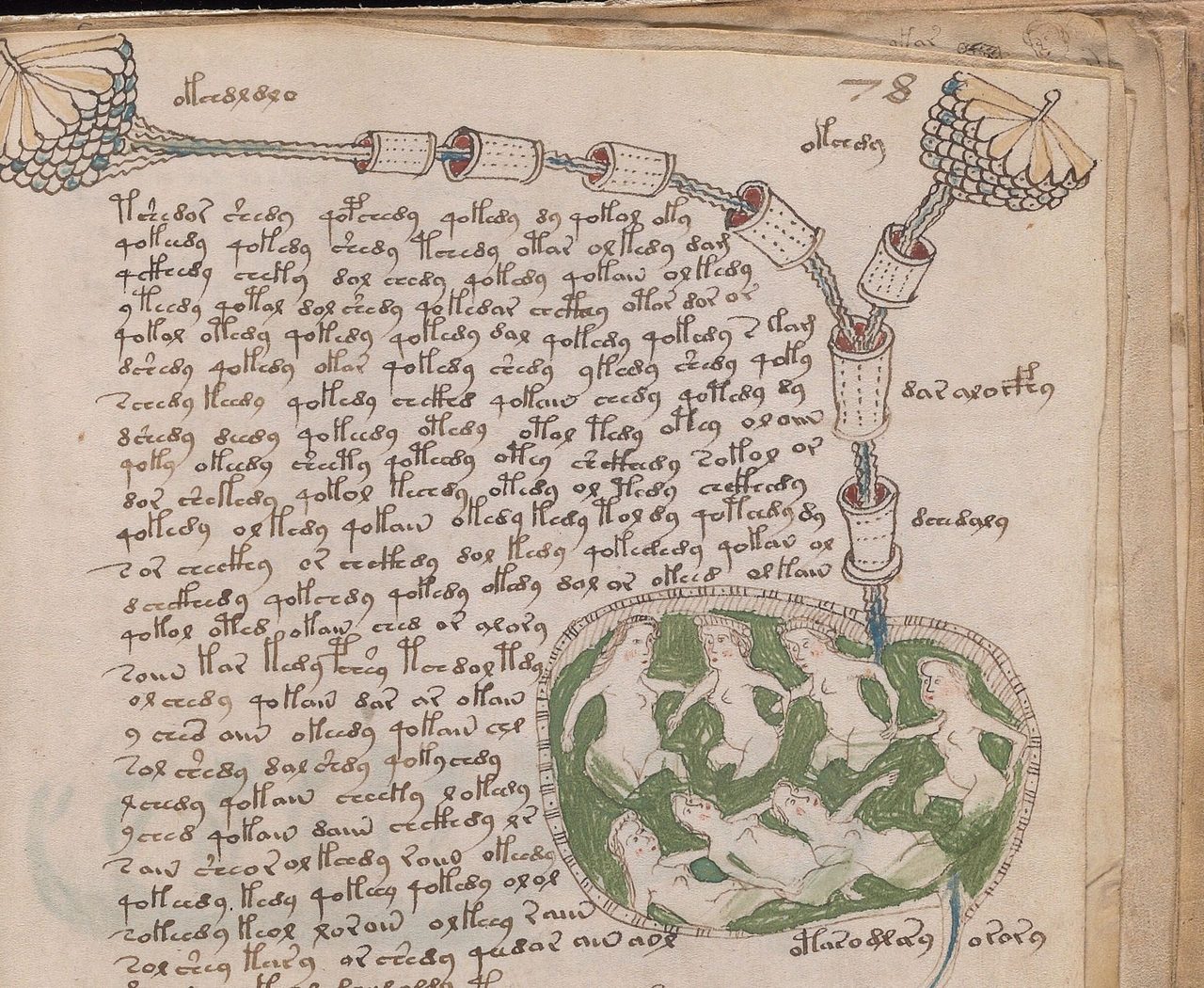
While the first channel was running, we were going through the labels at two vines on leaf f78r and ran one of them - oteoteotsho - through 57 corpora. As a whole it was found nowhere. But its core, ote-ote, a repeated syllable, heads the list precisely in Amirdovlat: 1.34 per thousand words, whereas among corpora of five thousand words or more nobody gives more than 0.42. And these are doubled names of remedies of Arabic root.
Next, a check that this is not an Armenian peculiarity. The Latin Antidotarium gives the same level for three-letter syllables: 0.53 %. After the corpus was topped up, the same words turned up among the Ottomans - hashas, mermer, bulbul, zemzem - and among the Copts. Three independent traditions. And a general literary Ottoman text has a density of 0.24 against 1.34 for the book of remedies. A trait of the genre, not of the language: remedy books love doubled names.
The number for the manuscript: 2.04 % of the types with a doubled two-sign group and 0.18 % with a doubled three-sign group - the band of remedy books, three times above prose. All 14 types with a doubled three-sign group are one nest: daldal, kalkal, oteotey. We recorded this as a lead: doubled syllables as a fingerprint of the genre.
A miss of a different kind
The lead lived a month. In September we measured the same quantity differently - as the share of types with a doubled two-sign group, olol, arar - and ran it through the generator. The manuscript 1.77 %, the canon 0.25-0.37 %, five seeds out of five below half the target. This is a defect of the model, and it is a relative of another defect - the adjacent repeat of a word: in the manuscript two neighbouring words coincide more often than in the model, and some of these repeats are written joined. A doubled syllable is a joined adjacent repeat. Not a genre of the plaintext but a property of the writing.
So the lead closed - not because the match with the remedy books was false, but because the manuscript has a closer explanation that requires no language at all. This is a miss of a special kind: the right observation, the right genre, the wrong level of explanation.
For understanding: four zeros close Armenian as the plaintext language under our class of cipher; the eastern plants of the herbal are neither explained nor refuted by this. Success would have been not a similar letter but an Armenian text that under the cipher gave the manuscript's profile - and none was found.
FAQ
Why was Armenian considered at all?
Because of the outward similarity of some signs of the manuscript to Armenian letters and because of the eastern plants in the herbal. These are weak arguments, but the project's rule is to develop a version first and judge it afterwards.
How was the similarity of letters tested?
Three ways. By fonts - Armenian is indeed closer than Latin and Greek, but Georgian Mkhedruli is exactly as close, which is a property of rounded cursives in general. By real manuscripts of the period - the signal inverted, the Armenian samples came out worst of all. By a blind quiz - the choice of Armenian was at chance level.
What are doubled syllables and why do they matter?
Words like ote-ote-y or dal-dal, in which a syllable is repeated twice. The manuscript has noticeably more of them than prose. We found the same density in Amirdovlat's fifteenth-century book of remedies and in the names of remedies among Ottomans and Copts - a trait of the genre of remedy books, not of a language.
How did it end?
The language is closed by four zeros. And the doubled syllables later turned out to be not a fingerprint of the genre but a consequence of the mechanism - in the manuscript they are a joined repeat of neighbouring words, and our generator under-produces them, which is a defect of the model, a relative of another known defect.