What is established
Thirty names per sign: what we know about the labels in the zodiac rings
The labels beside the nymphs on the zodiac leaves are the most "readable" part of the manuscript - short, unique, with a grammar of their own. We know they are not numbers, not full names and not random words. We know that the stem of a label is shared across a leaf. We do not know whose names they are.
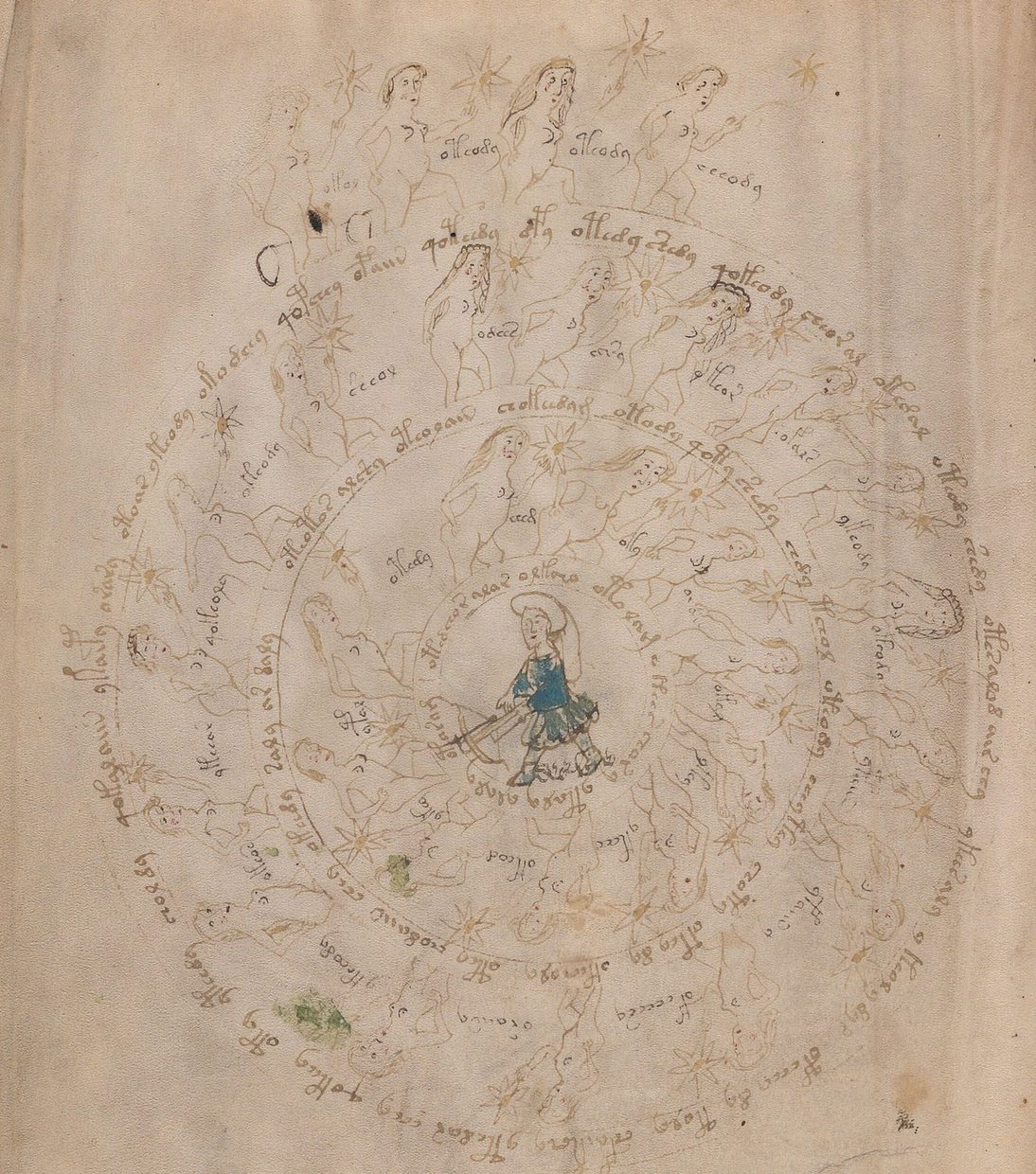
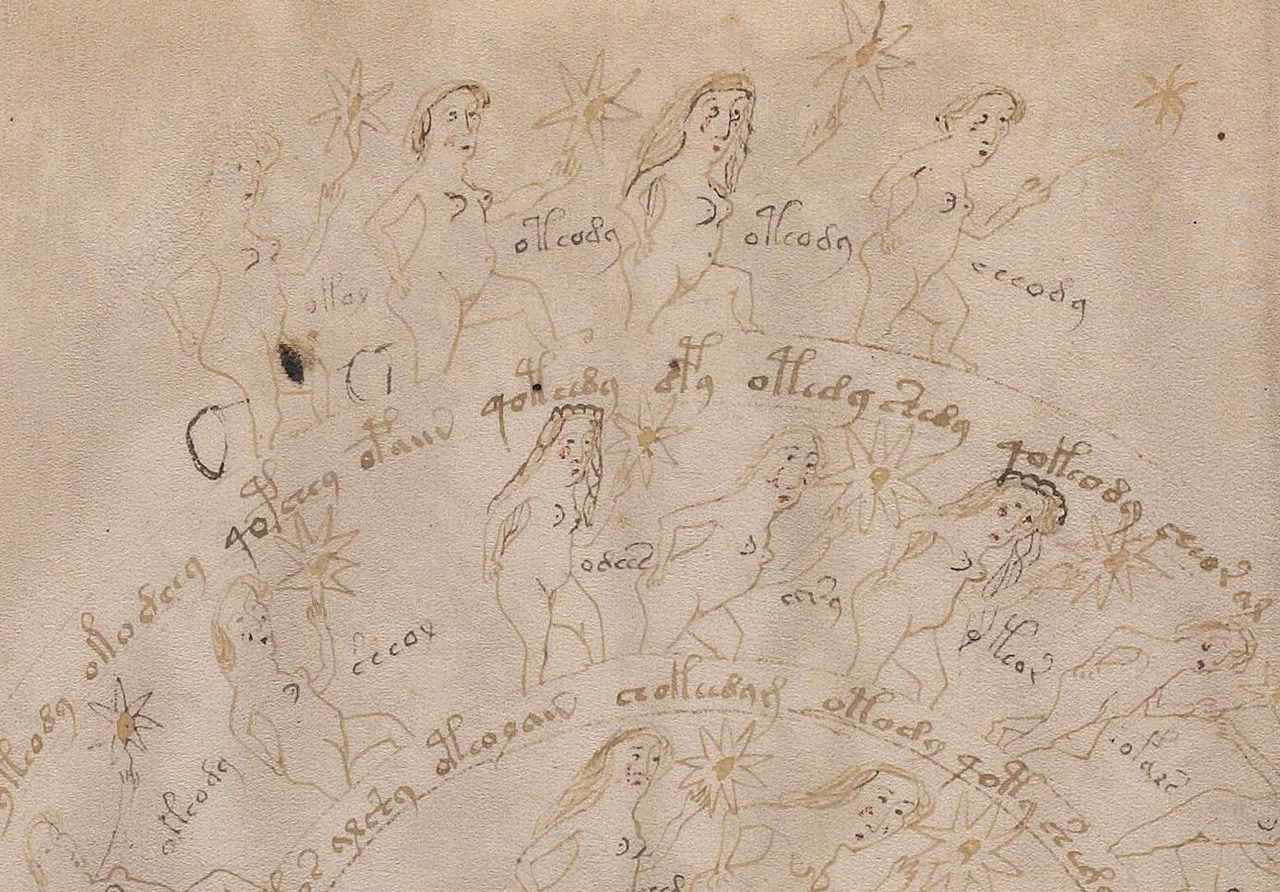
On the zodiac leaves of the manuscript, nymphs stand around each sign, each with a star in her hand and a short word beside her. For a hundred years these words have beckoned researchers: here they are, the captions, here are the names. Nobody has managed to read them, ourselves included. But in two years we have learned more about them than about any other part of the book, and that knowledge is structural, not verbal.
There are thirty of them, and they are unique
Start with the number. On leaves f73r and f73v there are exactly thirty labels each; averaged over the rings, about thirty unique ones per sign. Thirty degrees, thirty days - a coincidence one cannot walk past. At the same time the labels almost never repeat, either within a ring or between rings: the share of distinct forms among them is 0.77-0.80 against 0.20 in the ordinary text of the manuscript, and two rings have practically no labels in common (similarity 0.005). Every sign has a list of its own.
The first hypothesis suggests itself: these are numbers. We tested it in four ways, and four times it failed. The most vivid: neighbouring numbers are written alike - 21, 22, 23 share their first digit. If the labels were numbers, neighbouring labels on a ring would resemble each other. The adjacency measure in the manuscript is +0.8; for real numerals it is about +7. The labels do not count.
A grammar of their own
A label is not just a short word from the text. It has its own grammar, and we measured it with six markers. The null control matters here: comparing labels with the text head-on is unfair, because labels are shorter. So the tag "label" or "text" was shuffled within strata of "section × word length" - 90 strata, 10 000 permutations. Here is what survived.
| marker | in labels | in text | ratio |
|---|---|---|---|
initial o- | 53.8 % | 20.6 % | 2.6 |
initial qo- | 0.9 % | 15.2 % | 17 (rarer) |
doubled syllable (olol, arar) | 3.05 % | 0.57 % | 5.3 |
final -n | 7.5 % | 16.5 % | 2.2 (rarer) |
| doubled letter | 16.1 % | 24.9 % | rarer |
rare signs x, v, g, b | 1.92 % | 0.44 % | 4.4 |
All six are significant at the 0.001 level. A curious contrast: labels like a doubled syllable and avoid a doubled letter. The most frequent prefix of the text, qo-, is almost forbidden in labels - a change of register, as if a list of names were written without articles.
They are sigla
How long a name fits into a label? By the cipher tables of the Naibbe class, the words of the text map onto one-letter encipherments (expected length 4.43 signs against 4.45 observed), while the labels map onto two-letter ones (5.15 against 5.37). Not one of the 344 zodiac labels requires three letters. A full name does not fit. What fits is a siglum - an abbreviation to two letters, the ordinary practice of medieval lists.
Next came the check that convinced us more than any other. If a label is two independently enciphered letters, then pairs of labels within a ring should sometimes share exactly one of the two parts (a common first letter or a common second letter), and more often than chance. So they do: p below 0.001 in both directions. And the labels of the pharmaceutical section - unique plant names - give no such signature. So this is not a general drift of form but the specific design of the zodiac labels.
Later we refined this: a label needs no section of the key of its own. Label forms outside the lexicon of the tables decompose as "a key word plus one more cell run together" in 78.6 % of cases against 58.5 % for pseudo-words - exactly like unusual forms in the text. A label is two or three code units from the same key.
An independent witness
In a study where everything rests on the parse of one transliteration file, an external control is needed. One turned up: the dataset of Keito Yoshida, built from the same file with different code and published openly. We checked it against our parse: 883 loci out of 883, 1021 tokens out of 1021, 747 types out of 747, zero discrepancies, all ten locus classes agree. The label inventory is independently attested.
Where the content is
There is one more dimension that sets the labels apart. Compare the body of the manuscript's paragraphs with our generator and they are almost indistinguishable: similarity between lines 0.068 against 0.090, vocabulary share 0.198 against 0.107, entropy 2.18 against 2.10. The labels stand off from the generator on every axis: 0.006, 0.728, 2.53. The prose of the manuscript is statistically like a serial procedure; whatever is distinctive in the book sits in the labels.
The stem is shared across the leaf
The most recent finding dates from October 2026. We asked: is the stem of a label (its first signs) a property of the ring or a property of the leaf? If the labels are lists of names, the stem should sit on the leaf; if it is a scribe's dialect, it should sit in the text of the same leaf as well. The label stems are concentrated by leaf more strongly than the text words of the same leaves: z +8.05 against the text's 97.5th percentile of 3.52; two leaves of the same month give different stems (p 0.005). The labels are built like a nomenclator - a list with a shared opening per page. Power of the test 1.0, p 0.0004.
The next step - the tail of the label as the discriminator within a leaf - ran into volume: 244 labels longer than five signs on twelve leaves give no power (0.29 at a threshold of 0.8). This question cannot be settled on the labels we have.
Why the labels cannot be read
The labels are the manuscript's best anchor, and that is exactly why we spent the most on them: eighteen classes of external lists, thirty per sign, from the cisiojanus to the degree images of the Astrolabium of 1488 and the calendars of saints. One list - the Lleida calendar - passed three barriers and turned out to be an artefact. All the rest - zero.
And then the arithmetic takes over: even if we found the right list, thirty two-letter sigla are sixty letters. To recover a key of six tables one needs two orders of magnitude more. More in the article Anchor threshold.
For understanding: everything above concerns the form of the labels and their distribution, not readings. Success would be an external manuscript of the same tradition with a list of names, thirty per sign, and a shared stem per page.
FAQ
Why can the labels not be the numbers from 1 to 30?
If the labels encoded degree numbers, neighbouring labels would resemble each other the way the spellings of neighbouring numbers do. They do not - the adjacency statistic in the manuscript is 0.8 against 7 for real numerals. The rings share almost no labels between them. Checked in four independent ways.
What is a siglum?
A name abbreviated to one or two letters, the usual practice of medieval lists and calendars. The capacity of a label, by the cipher tables, is exactly two letters - a full name physically does not fit.
How sure are you that the label inventory was parsed correctly?
An independent dataset by Keito Yoshida, built from the same transliteration file with different code, matched our parse to the last sign - 883 loci out of 883, 1021 tokens out of 1021, zero discrepancies.
Can the key be fitted from the labels?
That was the project's main hope - an external list of names, thirty per sign. Eighteen classes of such lists have been tested and rejected, including the degree images of the Astrolabium of 1488 and calendars of saints. On their own the labels are too short to serve as an anchor.