Near misses
Twelve months in a foreign hand: what we learned about the annotator of the zodiac and what cannot be learned
On the zodiac leaves someone wrote in the names of the months - the only readable words in the book. We assembled a corpus of six thousand charters, tested 25 scribal traditions, re-examined the readings against multispectral images. Not one tradition reproduces the set of forms, and that in itself is a result.
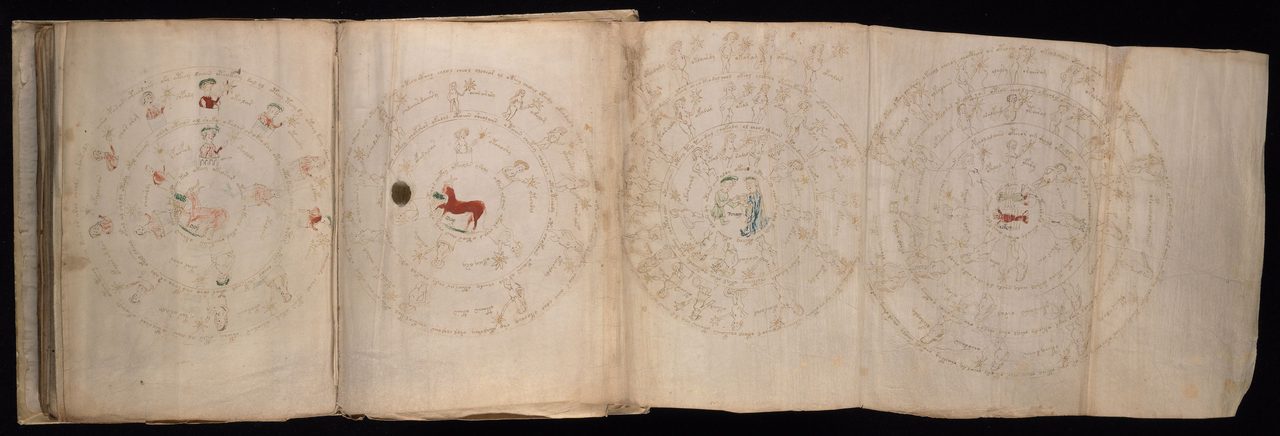
The Voynich manuscript has words that anyone can read. On the zodiac leaves, at the centre of each sign, a later hand has written in the names of the months in a Romance vernacular: under Pisces, March; under Aries, April; and so on to Sagittarius with November. A lead, it would seem: the dialect of these words could tell where the book was soon after it was made, and so narrow the search for its language and key.
We spent a month on this lead and came out with a result that was neither a victory nor a defeat.
A set that does not exist
The readings most researchers work with: mars, aberil (twice), may, yony or jong, iollet, augst, septe(m)b(r), octe(m)bre, nove(m)bre, dece(m)bre. Four forms are disputed: April with b, June, July and August.
The first thing we did was to assemble our own corpus of charters with date and geography: 335 cards from three diplomatic collections. aberil, jong, iollet - not once. augst - once, Langres, 1266. But octembre - 34 acts, all in the Arras-Douai core, in the far north.
Then we took the large Gallo-Romance corpus of the University of Zurich: 156 806 word forms, 6 284 acts, 37 scribal traditions with labels. octembre - 132 documents, north; octobre - 84, south. And abril with b - 32 documents, entirely south. North and south in one set.
The profile over 25 scriptae: the best gives 5 soft matches out of 10, and what matches is only what does not distinguish areas - may is everywhere. All four disputed positions - zero in all 25 traditions. The manuscript's set is reproduced by no area.
Three explanations and a test of the first
Three explanations: wrong readings; the annotator was not a native of the written norm; the genre and period of the corpus are wrong - charters of the thirteenth and fourteenth centuries against an addition of the fifteenth.
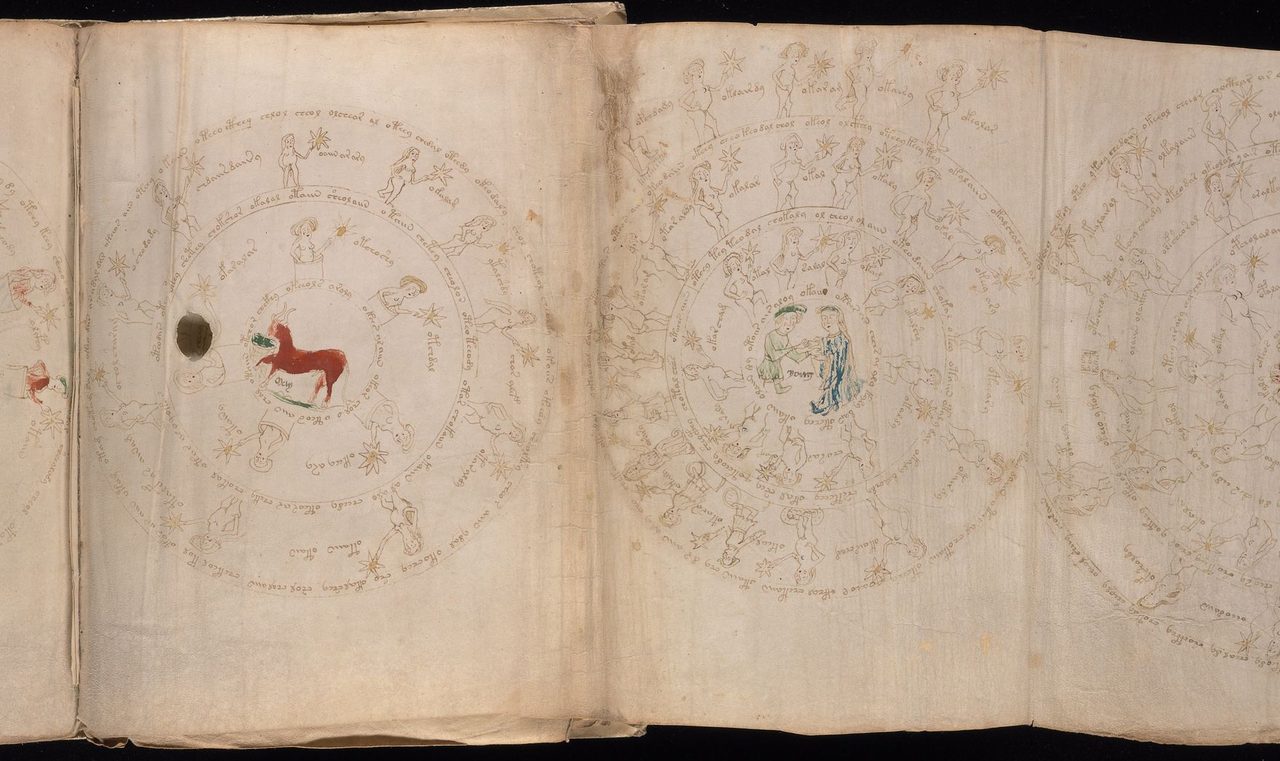
The first can be tested. Multispectral images exist only for the two leaves with April, and there the resolution is twice that of our archive: 277 pixels per word against 135. June, July and August lie on foldout leaves, where a letter gets 20-30 pixels - a ceiling we had already stumbled over in other tests. We set the crop coordinates before looking at the letters, and looked at one feature at a time.
June: an o in the second position and a descending tail at the end - juing and juin are excluded. August: the tail of the g is there - aoust is excluded. April: the loop of the b is there on both leaves - avril is excluded. July: the ending -et confirmed. The tittles over octe(m)bre and nove(m)bre are visible. The readings hold; the anomaly of the set is real. We tried twice to run a blind check of these readings and both times annulled it on formal grounds - and recorded honestly that the reading remains "medium, not blind".
A trail that narrowed and widened
In August 2026 a hint came from an unexpected direction. Checking the Hanseatic books for a north German version, we found in them Anglo-Norman documents of the trading posts - goule de Aust, gule daugst, daoust. A profile against the Anglo-Norman dictionary gave augst and octembre as exact dictionary variants, which no continental scripta had given. The scenario: an annotator from the orbit of the Anglo-Norman chancery, where French of this kind lived through the whole fifteenth century.
A day later a researcher from the forum showed, in a German manuscript of about 1450 from Schwäbisch Hall, the forms augst and aügst as ordinary south German ones. The specificity of the Anglo-Norman channel fell apart: compatibility without specificity. And in October we revised the southern conclusion too: octembre, which we had taken for a northern trait, is attested in Montauban from 1351, in Albi, in Bordeaux in 1406; abril and octembre stand together in the Bordeaux books. The north-south pair needs no mixing: the Occitan south-west and English Guyenne are no longer excluded. The four disputed forms, meanwhile, are still found nowhere.
What follows
The "north or south" dispute cannot be settled by the months on the available material. We softened the wording in both papers of the project: Romance-speaking Western Europe, fifteenth century; by the months, northern France is named most often, the Franco-Swiss border is discussed, the old Occitan version rests on an unverified attribution of 1997, and Guyenne and the Anglo-Norman orbit are compatible without proof.
The only lever that could move things is targeted multispectral re-imaging of the three foldout leaves with June, July and August. The 2024 release does not cover them. We have recorded this as a request.
For understanding: the months are an addition, not the text of the manuscript, and they have no bearing on the cipher key; the most they give is the area where the book was in the fifteenth century. Success would be finding a document in which all four disputed forms stand side by side - then the annotator's area would be fixed exactly.
FAQ
Who wrote the month names?
Not the scribes who wrote the main text. It is a later addition in a different hand and different ink, in a Romance vernacular. It is used to try to determine where the manuscript was soon after it was made.
What is strange about these names?
The combination of forms. Octembre with m is a northern trait, abril with b a southern one, augst occurs in both Anglo-Norman and south German documents, while iollet and jong do not occur in the assembled corpus at all. None of the 25 scribal traditions gives the whole set.
Could they not simply be read more precisely?
We checked the readings against scans and, where they exist, multispectral images. June excludes juin, August excludes aoust, April excludes avril - the anomaly of the set is real. The disputed July and August lie on foldout leaves with a resolution of 20-30 pixels per letter; re-imaging those leaves is the only lever.
What does this mean for the manuscript's origin?
That north versus south cannot be decided by the months. Several scenarios are compatible - the annotator was not a native of the written norm, the genre of the corpus is wrong, or the orbit of the Anglo-Norman chancery. In the project's papers we softened the wording to "Romance-speaking Western Europe".