Near misses
The Milan cipher of 1424: the first syllabic key of the manuscript's period - and why it is still not the one
For a long time we believed that syllabic signs appear in European ciphers only from the 1450s - later than the manuscript was made. The key reconstructed by Mark Knowles from intercepted letters of the Milanese chancery of 1424 refuted that. We tested whether it gives the manuscript's profile. It does not - and that is an exact number.
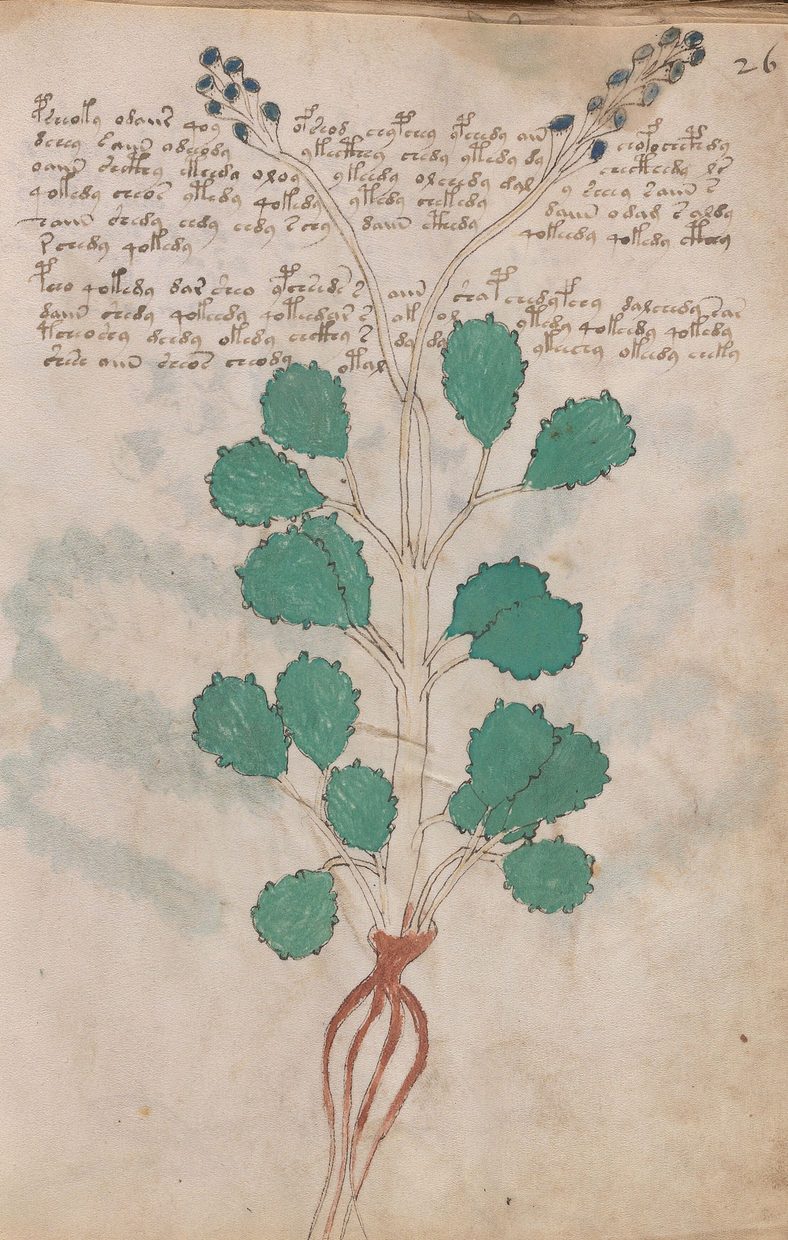
Radiocarbon dates the parchment of the manuscript to 1404-1438. Our model says the text is written in a cipher whose unit of substitution is the syllable. And until October 2026 there was an awkward spot in the reasoning: by everything we knew of European cryptography, syllabic signs enter the keys of the chanceries only from the middle of the century, with Tranchedino around 1450. The manuscript's workshop, it seemed, was some thirty years ahead of its time.
That is not impossible - but it is a weak point, and we went looking for it. We found it somewhere other than we expected.
What we knew before
By October we had brought together all the open sources of keys of the period. The DECODE database: 29 entries strictly in the window 1400-1440, syllabic signs - none. The Ilardi reels at Yale - microfilms with reconstructions of keys from Florentine intercepts of 1424-1530 and eleven keys of Siena. Meister 1906 - the keys of Petrus de Gratia, Lavinde, Canetoli. Tranchedino's book of keys, Milan, about 1475, with 287 systems. The picture was stable: before 1440, homophones and short code groups; syllables later.
Four letters from under Aquila
Mark Knowles, a British researcher who has worked for many years in Italian archives, posted three studies on the forum. The main one is an analysis of four letters of the chancery of Filippo Maria Visconti, intercepted by Florence in May-June 1424, before the battle of Aquila. The letters are kept in the Florentine State Archive; one of them comes with a contemporary decipherment, one can be read only under ultraviolet.
The key to them has been reconstructed twice: by the Florentine archivist Gabbrielli around 1865, in his sixteen-volume work on Florentine secret writing, and by Knowles himself in 2024 - from the letters, with corrections. The design, after Knowles: no nulls; more than two hundred distinct substitutions; single letters with homophones; about 150 syllabic signs - one per syllable, from ab and ba to gent and tratri; code words for names and frequent words - some written as groups of letters; and substitutions by Roman numerals: sum - XXVI, set - XVI. One unit of plaintext turns into a chain of signs. Knowles himself calls this the basis of a verbose cipher.
This is inside the radiocarbon window. Syllabic writing existed in the chanceries of northern Italy from at least 1424. We corrected our conclusion and recorded Knowles's work as prior art: he was the first to link the manuscript with Milanese cryptography and its low entropy.
The test by profile
A correction to history is one thing, the manuscript's profile another. We asked: if Latin is enciphered with the key of 1424, does the result resemble the manuscript statistically? Preregistration before the code, thresholds in advance. The syllable list was verified: 145 syllables, 35 % of the signs are groups of two to four glyphs. Two variants: Knowles's key and Gabbrielli's key, which differ in the number of vowel homophones and the length of the Roman numbers.
The result: the profile does not hold. A conditional entropy of 3.86 bits in the first variant and 3.55 in the second, against the manuscript's window of about 2.2. The difference between the variants is 0.54 bits - so the conclusion does depend quantitatively on the transcription of the key, but neither variant passes. The key of 1424 is syllabic but not verbose in the manuscript's sense: it has one sign per syllable, and the entropy does not fall from that the way it falls when a letter is replaced by two or three signs.
We tested the neighbours too. The unsolved ciphers of the same period - the Malatesta letter of 1428 and two Sienese documents - give, at equal length, 2.9 and 3.87 bits against 1.8 and 2.18 for the manuscript. The key of the Sienese chancellor Petrucci, in which 31 % of the letters have groups of Latin letters, gives 2.80 against the manuscript's corridor of 1.91-2.43. All higher by 0.4-1.7 bits.
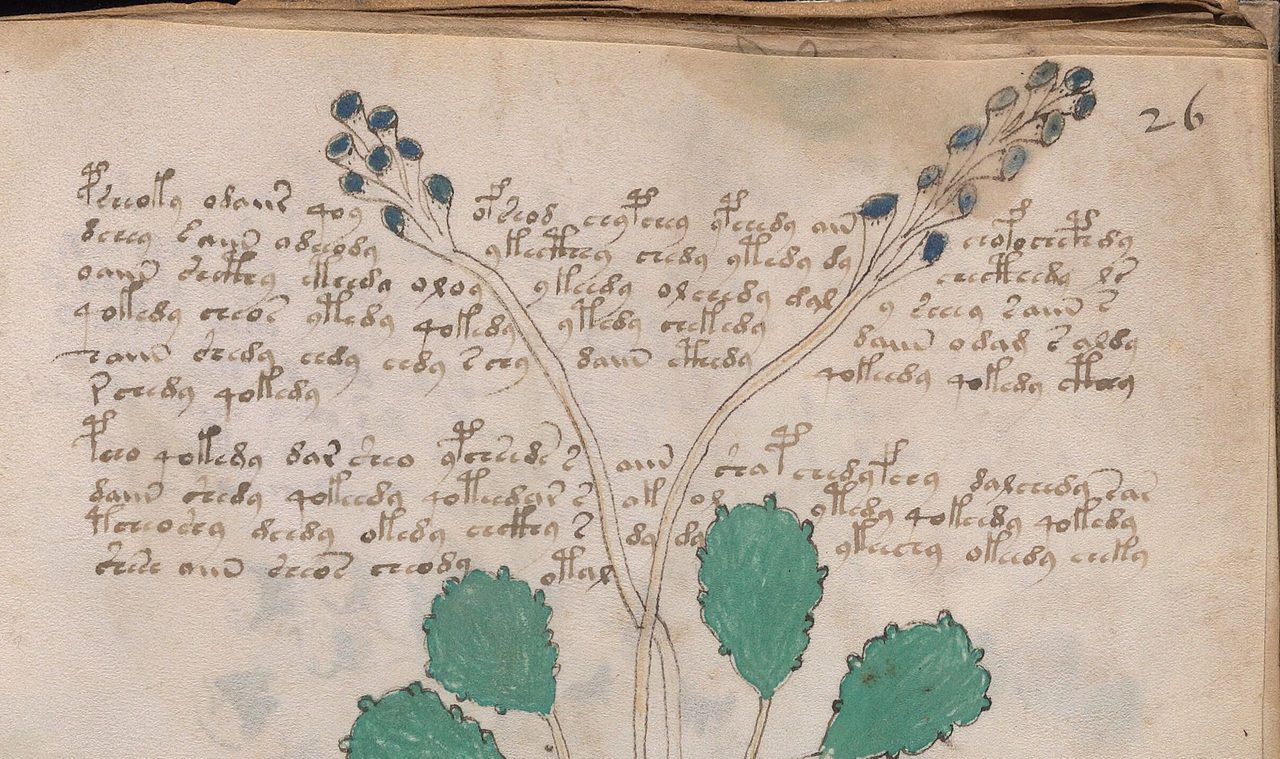
Numbers behind the chart
| cipher | h2 | manuscript at the same length |
|---|---|---|
| Milan 1424, Knowles key | 3.86 | 2.20 |
| Milan 1424, Gabbrielli key | 3.55 | 2.20 |
| Malatesta letter, 1428 | 2.90 | 1.80 |
| Sienese documents | 3.87 | 2.18 |
| Petrucci key, Siena | 2.80 | 1.91-2.43 |
What this changes
Three things.
First: the class "syllabic writing plus code groups" exists inside the C14 window. The statement "the manuscript's cipher has no specimen of its period" is withdrawn in its strong form; we are revising the corresponding line in the first paper.
Second: there is no specific specimen with the manuscript's profile among the known keys. The gap is not in details but in design - the manuscript's entropy is lower than that of any chancery cipher of the period, which means its mechanism inflates the writing more strongly than one sign per syllable. Our model, with two or three signs per unit, does exactly that.
Third: the archives where the right key may lie are known. Knowles drew up the map: Florence, Lucca, Mantua, Modena, Siena, Milan, Paris, the Vatican, Genoa, Foligno, St Petersburg. The fire of the castle of Porta Giovia in 1447 destroyed the Milanese cipher archive, so Milanese keys from before 1447 survive mostly in other people's intercepts. Images of most of them are closed by the Italian law on archives. This is the same task as in The hunt for the key, and it is not a statistical one.
The near miss here is literal: a key of the period and of the right class has been found, and it does not give the profile. Success would be a key of 1400-1440 in which syllabic and multi-sign substitutions make up more than half of the writing; of the known ones the closest is the Mantuan key of 1450, whose facsimile we have not yet obtained.
For understanding: everything above is about comparing the form of the writing, not about reading; none of the keys of the period was applied to the manuscript as a key, because none fits by its inventory of signs.
FAQ
Why does it matter when syllabic signs appeared in ciphers?
Because the manuscript, by our model, is written in a cipher whose unit is the syllable. If there were no such ciphers in Europe in 1404-1438, when the parchment was made, the model would require an invention from scratch. The Milan cipher of 1424 shows that syllabic writing already existed in the chanceries.
What is known about the Milan cipher of 1424?
Four letters of the chancery of Filippo Maria Visconti, intercepted by Florence before the battle of Aquila, are kept in the Florentine archive. The key has been reconstructed twice - by Gabbrielli around 1865 and by Mark Knowles in 2024. It has more than two hundred substitutions, about 150 syllabic signs, code words and chains of Roman numerals.
How did you test it?
We enciphered a Latin text with this key by Knowles's rules, then by Gabbrielli's variant, and measured the profile - entropy, vocabulary, doublets - at equal volume with the manuscript. Preregistration before the code, thresholds set in advance.
What is the outcome?
The profile does not hold - an entropy of 3.86 and 3.55 bits against the manuscript's window of about 2.2. The conclusion does not depend on the variant of the key's transcription. The unsolved ciphers of the same period - Malatesta 1428, Siena - are also 1.1-1.7 bits higher. The class exists in the period, but a specific specimen with the manuscript's profile has not yet been found.