What is established
Five scribes, one key: how the manuscript betrays that it was written from shared tables - and by double leaves
A palaeographer distinguishes five hands in the manuscript. Statistics show that all five used the same spelling variants in the same proportions. And the double leaves of the book resemble each other beyond adjacency - it was written bifolio by bifolio. The most "production-line" part of our findings.
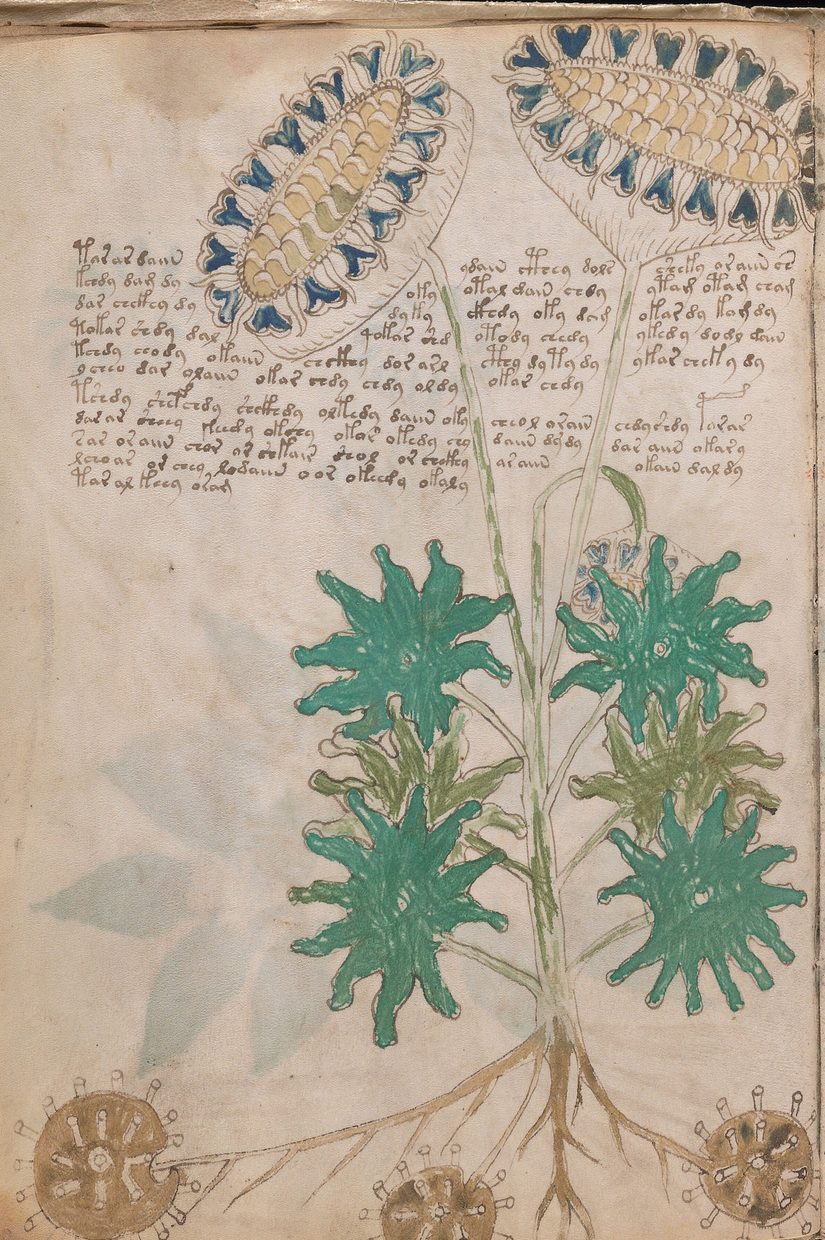
The Voynich manuscript is usually spoken of as the book of one man - an author, an encipherer, a hoaxer. The data paint another picture: a workshop. Several people, a shared technology, a production rhythm. This article is about three findings that add up to that picture, and about the boundary beyond which it does not yet go.
Five hands
In 2020 the palaeographer Lisa Fagin Davis showed that the text of the manuscript was written by five people - by the shape of the letters, the slant, the peculiarities of the joins. Her marking became an external given for us: we did not recount the hands, we asked how they relate to the design of the text.
The key question was this. The text has many word doublets - pairs with formally different spelling and identical behaviour: ol and chey, daiin and chol. By our model these are spelling variants of the same thing, homophones. If each scribe worked from his own tables, or simply by his own habits, the distribution of variants should diverge between hands. If from a shared key - converge.
The result: the doublets across the five hands are more alike than in controls. The divergence between hands is 0.050 against 0.163 for control pairs, p less than 0.001. All five used the variants in the same proportions. These are not habits - these are tables, the same for everyone. The technology of a scriptorium, not a handwriting.
A dialect per quire
The second production trace is clustering. The words of the manuscript come in waves: over one stretch certain forms run thick, then they give way to others. This was measured long ago and interpreted in various ways, up to "a change of topic". We showed that the clustering is reproduced if on each stretch of text the scribe works with a subset of three tables out of six - a sectional dialect.
The length of the stretch is a finding in its own right. We searched it under an acceptance rule set in advance: at 40 lines the model did not hold the Taylor exponent, at 220 lines it holds it on 9 seeds out of 10 within 10 %. 220 lines is the median quire of the manuscript. The scribe changed his set of tables roughly once per quire.
From the same thing follows the long-known division into Currier's "languages A and B": these are not two languages but two lexicons of one system - different subsets of the same tables, assigned to different parts of the book. The dialect is local to the quire and passes from scribe to scribe together with the tables; on one foldout leaf it changes together with the hand.
Someone else's measure confirmed this independently in October: clustering by Masciopinto's battery is 4.83 for the canon at a threshold of 4.77, and 3.63 without the sectional dialect.
The bifolio as the unit of writing
The third finding is the most recent and the most unexpected. A parchment sheet in a book is not a page but a bifolio: a double sheet folded in half, four pages. Two of them lie on one side of the unfolded sheet and were in front of the scribe at the same time. If he wrote bifolio by bifolio, rather than page by page in reading order, then the conjugate pages of one bifolio should resemble each other beyond what adjacency in the text gives.
We took the profiles of transitions between signs on each page and compared conjugate pairs with reference pairs - pairs from the same quire, at the same distance, in the same language and the same hand. 23 pairs. The conjugate ones are closer: T -0.048, z -5.18. Parity with another researcher's independent seriation - 3.52 % against his 2.29. The canon does not carry this (d -0.19 at a threshold of 0.5), and it became the twentieth open defect of the model: in the model the page is the unit, in the manuscript the bifolio.
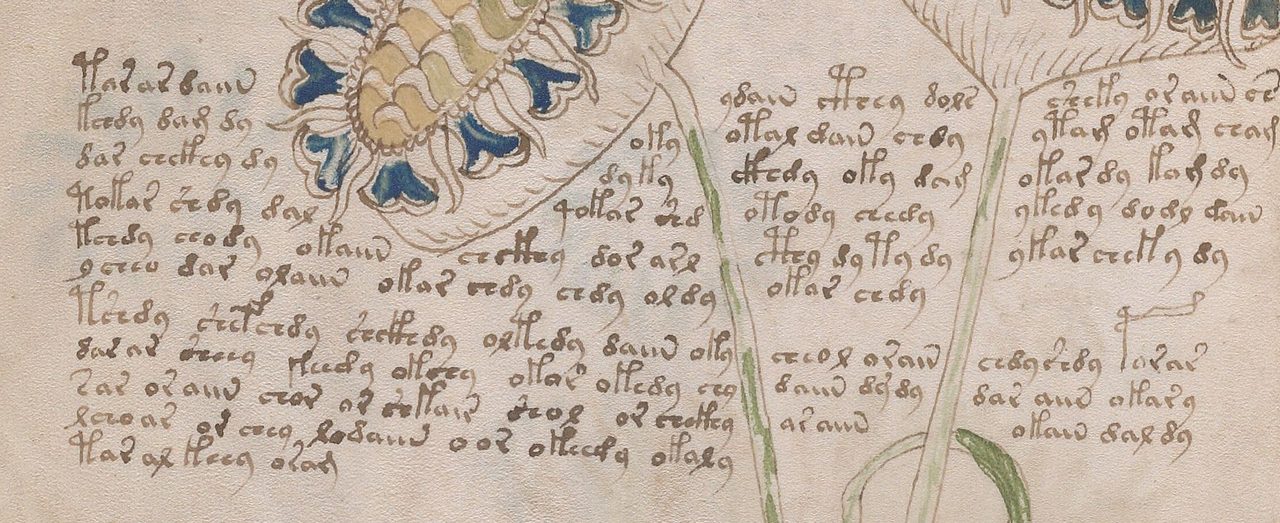
A second measure of the same thing: vocabulary affinity. Conjugate leaves share words more strongly than reference pairs (z -2.21, p 0.025); the canon does not carry it (d -0.16). By section: the herbal gives z -4.10 descriptively, which runs against the recent conclusion of other authors that there is no effect in the herbal.
This agrees with what we know about the workshop's way of working: the tables in front of the eyes, the bifolio on the table, two pages in one sitting.
The boundary: the order of the bifolios
Hence a natural question: are the bifolios bound in the right order? For several quires - especially the "bathing" Q13 and Q20 - this has been discussed for decades. Recently a method was proposed: the similarity of page content by latent semantic analysis, and the order that maximises the similarity of neighbours. Two researchers obtained consistent results with it.
We reproduced the method with our own implementation (672 documents, 2 193 terms against their 606 and 2 161). For Q13 our best order matched theirs; for Q20 - almost. Then we asked: is this order significant against chance? The null is a random assignment of pages to bifolios, followed by the same search. The manuscript: p 0.81 for Q13 and 0.70 for Q20. The best order is no higher than what the search finds on a random assignment. We tried a second null that preserves a page's place within its bifolio: it is calibrated but has no power - it does not catch a planted order, because it preserves the pairs of similar pages.
The conclusion is narrow, and we insist on it: the LSA method does not distinguish order without an external null; "there is no order" does not follow from this. The agreement of two researchers on these quires proves nothing - a search for the same maximum will give the same thing.
For understanding: everything above is about the production of the text, not its content; five hands, a dialect per quire and the bifolio are facts about how it was written, not what. Success would be an external witness of the order - an ink trace, a numbering or a tear in the parchment - that could be checked against any statistical order.
FAQ
How many people wrote the manuscript?
By the palaeographic analysis of Lisa Fagin Davis - five. We took her marking as an external given and asked whether these five people worked from one key.
How can statistics show a shared key?
Through spelling variants. If each scribe had his own table or his own habits, the word doublets would be distributed differently across the hands. In the manuscript it is the reverse - the doublets across the five hands are more alike than in controls, a divergence of 0.050 against 0.163, p less than 0.001. All five took their variants from one source in the same proportions.
What is a bifolio and why does it matter?
A double sheet of parchment folded in half - four pages, two outer and two inner. If the book was written bifolio by bifolio rather than page by page, two pages of one bifolio should resemble each other beyond what adjacency in the text gives. And so they do.
Does this mean the leaves of the manuscript are bound out of order?
For some quires this has long been discussed. We tested the popular method of recovering the order - it gives no result significant against chance, because an honest null for it is hard to build. The order of the bifolios remains an open question.